Naturally, it all makes for a good story. I too once had a landlord I wanted to throw rocks at.
But there are plenty of pitfalls to wedding an evaluation of an artist’s work to their biography. One is the way in which this story quickly degenerates into cliché with each retelling. We know how these stories go: Jackson Pollock drunkenly raging and stumbling about while being dragged under by his own insecurities, Charlie Parker somehow radically changing the nature of music between heroin nods, Van Gogh cutting off his fucking ear. And something something something about their "demons." All good stuff for some bio-pic that’ll drum up moderate returns, but inevitably falling far short when it comes to explaining anything about what an artist accomplished. Nothing that adequately explains how their work was a “game changer,” or about the game that was changed, or why that game was possibly in need of changing, or about why any of this mattered in the first place. Nothing that explains the alleged greatness or “genius,” and certainly nothing about how said art may have been problematic in its time, but widely accepted and praised in the years after the artist’s death. Or, in the case of Caravaggio: the other way around.
* * * *
II. ATTRIBUTION
Disputes over proper attribution are bound to coalescence around any artist who’s been dead for many centuries. As with so many other artists, so it’s been with Caravaggio. First there’s the array of sordid details – his scurrilous misdeeds, criminal offences, etcetera. About which the various accounts offer a fair amount of conflicting and contradictory info. Then there’s the matter of the man’s work itself, and which paintings can be rightfully credited to his hand, and the questions about which ones were done by students and imitators. The earliest accounts of Caravaggio’s life and work – brief though they might have been – were written by critics and contemporaries during or shortly after Caravaggio’s lifetime. Many of these dwell extensively on the artist’s temperament and exploits, offering a portrait of a reprobate, a shameless opportunist chasing after prestigious patrons, a habitual brawler and criminal offender, a denizen of the most undesirable layers of society. It’s possible that many of the earliest accounts were penned by critics who simply disliked the man, disliked his paintings, and were incredulous with the degree of artistic influence he had throughout the Baroque era.
Such might be the case with the overview offered by Giovanni Pietro Bellori. Published in his 1672 volume The Lives of Modern Painters, Sculptors, and Architects, Bellori’s account is largely devoted to cataloguing Caravaggio’s careerism and misbehavior than to discussing the artist’s work. But when Bellori turns his attention to Caravaggio’s paintings, the verdict is a harsh one. He conceded that Caravaggio was vastly influential on younger artists of his day, but dismisses the results as an art hinging on “novelty,” mere stylistic apeings of Caravaggio’s “facile manner.” Bellori liked the early phase of Caravaggio’s career, but – as more and more of each slips into swathes of darkness – much less so with the artist’s more renowned mature works. He seems especially troubled by Caravaggio’s disregard for working from sketches and classical models, his practice of working directly from observation. This break from traditional practice resulted, Bellori lamented, in an art in which “the antique has lost all authority.” With that in mind, Bellori summarizedW:
"...Many of the best elements of art were not in him; he possessed neither invention, nor decorum, nor design, nor any knowledge of the science of painting. The moment the model was taken away from his eyes, his hand and his imagination remained empty.”
Such was the consensus among a number of critics and patrons, both during the artist’s lifetime and over the next several centuries that followed. The gauge here was the art that had preceded the Baroque – the High Renaissance work of Da Vinci & co., and the convulsive vibrancy of the Mannerists who soon followed. The art of the previous era, the argument went, involved a process of extensive drawing, planning, development in the preparatory stages; a process in which subject matter was skillfully transformed – manipulated, idealized, refined, sublimated – by the artist’s imagination and intellect. By contrast, Caravaggio shrugged off established methods and classical models, opting instead to dumbly paint whatever was in front of him. Hence, he was little more than an impassive technician, “lacking inventiveness” – a mere imagist, but not a painter in the true, post-Renaissance sense of the word.
* * * *
III. SLIPPAGE
Slippage is also an issue here, as well. The account offered by André Félibien, is translated as asserting that Poussin – a friend and confidant of Félibien-- “could not bear Caravaggio and said that he had come into the world in order to destroy painting.” Another, more anecdotal, version is more specific; and contains a curious qualifier. On first viewing Caravaggio’s “Death of the Virgin,” Poussin is said to have cried out:
“I won’t look at it, it’s disgusting. The man was born to destroy the art of painting. Such a vulgar painting can only be the work of a vulgar man. The ugliness of his paintings will lead him to hell.”
"I didn't design the layout of Brasilia. I just did its architecture. And it's a place where the buildings count for a lot. The city is flat. The horizon stretches away endlessly." - Oscar Niemeyer
Misc. notes on architecture
Re, the Modernist affinity for geometric simplicity, and the flat roof. Boxes with lids on them, more or less.
Granted, the flat-roofed structure has been around since time immemorial, being the direct descendent of the most rudimentary of architectural configurations, the post-and-lintel affair. Due to this lineage, one might describe it as "classic" in a sense. But perhaps only classic by default, by base necessity, since the prior mode of default mostly meant scouting out caves and the like. Post and lintel basically meaning walls and roof -- support and shelter. The rudiments.
The lintel element being -- by extension -- the flat roof. Which would become the basic structural feature thereafter, especially for buildings that served the most basic purposes -- be they domestic or institutional. Such things lack grandeur, speak in too humble of terms.
SO: The flat roof being a matter of default throughout the ages. Until the twentieth century, when High Modernism brought it back into style, made it a matter of preference. Modernism, with its guiding principle of purity and all that -- banishments of ornament and excess, form following function for the sake of improving (and aestheticizing) the built environment. That sense of purism extending to the reductivist basics of modular geometrical volumes -- permutations of the square and rectangle; the rectitude of -- as Le Corbusier would put it -- the right (i.e., 90-degree) angle.
All of that aside, there are inherent disadvantages to the flat roof, the sort that pose issues for the longevity of the building. One of course is the simple matter of water; which can collect in puddles along the plane of the roof, causing leaks which thereby incrementally shortening the integrity of the structure (not to mention adding to all sorts of laborious, expensive, and continual maintenance).
From an engineering point of view, the sloped roof has its upsides (no pun intended); mainly because it channels a lot of the gravitational taxation out towards the corners, where the corner beams could divert said forces right back down into the earth. But you lose that with a flat roof. Especially if its ceiling is low, and the structure sprawls. In which case it requires -- like the sort that covers any vast acreage (a factory, say) -- an optimum of load-bearing supports within. Basic physics, really. The more weight put upon a roof (be it the heavy accumulation of seasonal snows, a recreational deck or helipad, or the simple stacking of additional storeys), the more it needs to be reinforced from within, and extensively throughout. Stress-points have to be diffused – equally dispersed.
Such pragmatic considerations aside, there were plenty of other reasons to beat up on Modern architecture; and plenty of critics have lined up to do so in recent decades. Much of the criticism extending beyond considerations about form, focusing instead on issues of functionality. In this respect, it sometimes adopts the posture of a type of Adolf Loos-ish civic-virtues sanctimonious blowholing; which at times comes across as disingenuous, the anti-"purity" puritanism often hanging on the speaker as smartly as a second-hand suit.
At any rate, Le Corbusier is the favorite target for critics of Modern architecture; particularly his "Radiant City," which is overwhelmingly cited as the ultimate in bloodlessly "rational," dystopia-via-utopian urban planning. And yes, to look at the drawings and the model, one can't argue with that assessment. But it was never built or realized, if only because it was unbuildable and unrealizable, which is undoubtedly for the better. But there’s always Brasília, which was built and exists as an actualization of a similar plan. Like Corbu’s scheme, it's been described as inhumanly sprawling and impersonal, too aesthetically elitist and "absolute" in its grandeur. Similarly, it’s also been assailed for being too organized around the culture of roadways and the automobile; its expanses exceedingly unfriendly to pedestrian traffic and difficult to reach or navigate on foot. So while on one level – as a series of containers for administrative and bureaucratic activity – the city serves its function. But on another level, a much more logistical and symbolic level, one might argue it fails to fulfill its purpose.
Or so it’s said. Perhaps, dunno. I'm neither an architect nor an engineer, and I imagine this sort of thing is better left to those with the requisite expertise. What's more, I’ve never been to Brasília. But from appearances, the structure seems to be bearing up fairly well. Not only that, but it's still looking quite grand at the same time.
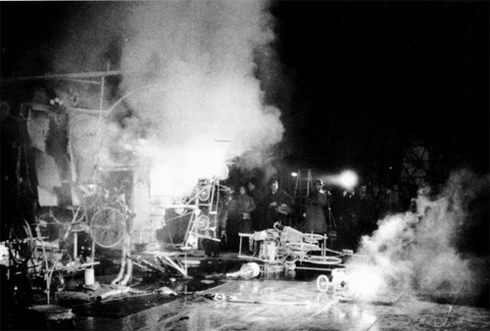
It was conceived as a sort of ballet mécanique. Wheels set into motion by a complex network of pulleys; a robotic automatic painting device churning out random patterns of pigment; a flaming upright piano automated from without -- its keys being unharmonically hammered by an array of pistons; a go-cart racing madly in place; an inflating weather balloon; a bathtub filled with a smoking chemical concoction; a fire extinguisher discharging aimlessly; numerous bells and klaxons. Flames, smoke, intricate engineering amounting to nonce spasmodics, eventually collapsing in on itself. Perhaps the flames provided warmth on a cold New York evening, provoking a few of the huddled spectators to lean in closer that they should, risking endangerment. Did the museum have the foresight to take out a liability policy in advance, or have attendees sign a waiver on admittance? Not likely.
The ballet at hand being Jean Tinguely’s “Homage to New York” as it was presented to the public for its "performance" in the sculpture garden of the Museum of Modern Art on a winter evening in early March, 1960. Assembled from a load of rubbish carted in from a garbage dump in neighboring Newark. Tinguely enlisted the help of Swedish-born engineer Billy Klüver during construction, with Robert Rauschenberg contributing a "money-throwing machine" to the works. Its operational lifespan lasted – by some accounts -- less than a half-hour before it began to fall apart, catch fire, and the New York Fire Department intervened on the side of the public behalf, with some of the audience boo-ing them for ruining the event by performing their civic-minded service.
Even though it was a machine designed to serve a function, a function that was effectively dysfunctional, it failed. Portions of the contraption that were supposed to do one thing or another did something else or nothing instead, and needed some interventional nudging on the part of the artist. It was devised to be a catastrophe -- involving equal parts contrivance and chaos -- and once it was set in motion, the catastrophic inevitably ensued. Clanking and grinding, smoke and flames. And in the end, debris. Wreckage and scattered parts to be picked apart and taken home by the witnesses, with the most desirable remnants being claimed by the Museum itself. From junk to salvage, twice over. Three weeks’ worth of parts and labor for something that would undo itself within a short span of a late evening.
Speaking of the '70s blog, I suppose this topic could serve as something like a "prequel" to that bit I wrote a good while ago about Bowie's "Berlin years." But between his being back in the music news in recent week combined with a couple of other incidental things, I find myself revisiting the topic...
I guess you could say that, once upon a long-ago, Bowie had been a major formative musical influence -- or at least he was in my early teens, about the time Scary Monsters came out, when I was reaching that age where I was developing a bit of taste-shaping autonomy, starting to proactively take an interest in music and seeking out things that I liked or found interesting (as opposed to being a passive recipient for whatever pap spilled out of the radio). That lasted for a couple of years, and then I soon moved on, and didn't listen to Bowie at all for about 25 years or so.
When I revisited some of his '70s material several years ago, I found that the albums I favored most were still the ones that I had liked most years ago. Mainly, the better portion of Station to Station, and the first two-thirds of the "Berlin trilogy." And also Hunky Dory, mainly for the way it reveals Bowie finally finding his voice as a songwriter, via a set of mostly amounts to his most nakedly personal, honest songwriting.
But recently a friend passed along the entirety of Bowie's early discog, including some things I'd never bothered with back in the day. First, there's Pin-Ups, which I avoided back when because I knew it was an album of cover tunes. And then there's the self-titled David Bowie album of 1967, representing pre-glam portion of Bowie's career. These two make for a interesting contrast when played alongside each other, prompting one to wonder, "So, Dave -- back in the 1960s you were really grooving to Syd Barrett and The Pink Floyd, the Pretty Things, the Kinks and the Yardbirds and whatnot -- during that same time that you, as an aspiring pop artist, were jockeying to become the next Cliff Richard?"
Perviously, there were only two songs from the early days of Bowie's career that I was familiar with, neither of which turned up on the 1967 album in question...
That second one, by the way, was arranged and produced hit-making maestro Tony Hatch, the man most known for making Petula Clark a huge success at the time. (Yet even with that sort of backing, Davey was still unable to get on the charts). Hatch also did this number, in which the "sound of the Seventies" sounds like it's stuck in the '60s. I used to sometimes use it to get my old radio show off to a jaunty start, beginning things by lobbing in a curveball...
There was long radio piece pianist Glenn Gould did for the CBC back in 1967 entitled "The Search for Pet Clark." It amounted to an eccentric and meandering travelogue about driving through the mountains somewhere in Canada as the car radio signal washes in and out, which ultimately takes the form of an extended paean to the work of Tony Hatch. UBUWEB used to have the entire thing up on their site, but it seems the CBC had them delete the entire page for Gould a long time ago. But there's some discussion of it in this recent article about Gould's "contrapuntal radio" works here.
At any rate, picking up where things left off some weeks ago...
Tthe whole volleying of drummage & riddim t'ings has continued all this time that I've been on involuntary hiatus. Simon's latest roundup on the matter hinges on the role of the crucial role of the drummer in a power-trio context, he observing "by definition a power trio must have a good drummer because otherwise the whole thing topples, there's no compensating for a subpar limb when the animal is three-legged."
Which brings to mind some straggling thoughts I'd had after I figured I spent my thoughts on the topic. Something that falls outside the prior funk/jazz/soul spectrum. Although maybe not entirely outside that spectrum because it requires a sidestep into the prog/fusion canon.
But something having to do with crucial role of a drummer in a trio situation, especially in the instance when the drums is not only very primary in a very central and frontal way, but also when the drummer in pulling double duty as vocalist.
Anyway: "Prog" and its jazz-derived time signatures, its basis in rhythmic gymnastics and the like. Admittedly, I've never been much into prog. With the one main exception being Soft Machine, who I finally cottoned to quite late. Or at least Soft Machine while Robert Wyatt was in the outfit, since it was his presence that proved the main point of appeal to my ears. The voice, the songwriting, the wee bits of whimsy and humor he at times brought to the music.
Sadly, drumming exited the equation altogether after Wyatt suffering his crippling accident in 1973. As far as technique and skill are concerned, I can't say how Wyatt rated as a drummer when stacked up to contemporaries like Ginger Baker or Mitch Mitchell. There are times, especially on the first Soft Machine album, where you sense he and the band are getting a little too ambitious, slightly overshooting their abilities on some of the more complicated twists.* Having had a lifelong interest in jazz, Wyatt once said in an interview that he knew he'd never consider himself an accomplished drummer, if only because he would always compare himself to the drummers he admired -- first-league jazz drummers like Max Roach, Tony Williams, and Elvin Jones. For that reason, he said, he'd learned to content himself with his abilities as they were, choosing instead to concentrate of exploring and developing what he could do with his voice, instead.
(In another old interview clip, Wyatt explained why he and the band opted to play in non-stop suite form -- having all the song run together with nary a break between them. He said they opted for that format when touring the U.S. as the opener for the Jimi Hendrix Experience. Feeling meekly overshadowed by Hendrix & co., they expected they'd meet with a negative -- if not hostile -- response from the American audience. So by eliminating pauses and stringing all the songs together, they figured they could stave off the jeers, or at least drown them out.)
At one point, a contributor to an earlier installment of Simon's thread cited This Heat's "24 Track Loop." Not so much a power trio, but a trio capable of delivering a great deal of power, thanks to vocalist and kitman Charles Hayward as the dynamic core of the much of the action; and -- as with Soft Machine -- the drums frequently playing a very central and prominent role, being the engine that propels the material. The same being often the case with Hayward's post-This Heat project Camberwell Now...
This Heat were one of those odd, slightly incongruous entities at the time -- another instance, as was the case with a few other groups of the era, of a unit made up of members who were older that many of their punk/post-punk peers, and who came from a background that ran contrary to the usual punk pedigree, but were draw to the music and to the scene for the experimental potential it offered. In this case, Hayward and Christopher Bullen came to post-punk by way of playing free-form, improvised music; and had spent a good portion of the 1970s kicking around on the margins of the prog scene, with the former having started out playing in an outfit with Phil Manzanera and Matching Mole bassist Bill MacCormick. This latter prog connection makes perfect sense in a way, if you consider This Heat as a post-punk equiv of Soft Machine, except with the Canterbury and overtly jazz aspects replaced with a krautrock-ish minimalism and experimentation.
* Which in a way connects with something about Wyatt that I immediately found endearing, something that you hear in his voice and his lyrics, as well. That being a bristling against limitations, which disarmingly suggests an all-too-human frailty and a sense of humility. (Which, in its turn, runs to the contrary of so much of the pomposity and mystical bullshit that plagues large portions of the prog canon.)
Re: Simon recently riffing on a new enthusiasm of "Notes for a Future Study of New Wave," which he feels mostly feel between the cracks of Rip It Up..., and our subsequent exchanges on the topic remind me of entries I had thought of for the immediately aborted "Three-Minute Zeroes" series of toss-offage I started on some off-the-cuff whim some time ago.
"New Wave" having been a tricky biz in the US back when, mostly a hazily incoherent catch-all -- part music-industry marketing strategy, but mostly convoluted misundertandings of what might (or might not) be "punk" in other respects.
So, subjectivity in such matters being what it is, here's a few previously shrugged-off candidates for the 3-Minutes Zeroes category, the New Wave edition...
I'll probably catch shit for this one, which was why I balked at doing one about it earlier. I owed a few of Romeo Void's records back when I was in high school, and try as I might, they never quite took with me. At best all I could hear was a West Coast art student take on X-Ray Spex, albeit one that was mostly more moody and downtempo due to various post-punk influences. At any rate, the above was the only thing they did that grabbed me.
First: The opening guitar riff -- wonderfully scrape-y, alternately tigthening and releasing tension -- hit me as being up there with "You Really Got Me" attention-getting intros. Then the drums, which -- yes -- are fairly alright. But it's when the bass comes briskly lumbering in that I was ready to start doling out hugs. And the guitars maintaining a stratchy rhythmic steadiness throughout, sputing up the occasion shards of concrete jumping out at the listerner. And the vocal, which -- as it slides in after the opening -- sounds like it's blaring from a squawky PA from ahalf a block away, delineating a narrative whose cadence you almost picture falling and finding its own breakage on the page like the offhanded observational poetry it was, invoking some variety of behind-closed-doors sorditries, which apparently routinely occurred someplace where sunlight didn't so often glimmer as physically land.*
A sum of its part, at a particular moment, and far better than most at that particular moment. An underlying bleakness beneath all its energetic fuss. Amounting to content-wise being perhaps a few years ahead of the sociological curve. What, with the blunt acknowledgment of homelessness some years before it because a big Big Recognized Issue; and with a chorus would quickly seem taunting and maybe quaintly utopic once hets realized that the epidemic of AIDS wasn't as selectively fatal as everyone had been led to believe.**
Beantown act, and everything else I heard by them -- with the exception of the 12" version of the above -- struck me as unbearable at the time; like a bad, faux-camp knock-off of Devo as done by a buncha Rocky Horror Picture Show enthusiasts. But with the above: Severe minimalism with some sped-up oscillating guitar biz, lyrics that might be detailing the dynamics of emotionally-abusive relationship but are ultimately just some tawdry, winking flirtation with then-fashionable s&m entendre. Soon enough the vocal dives into some multi-tracked fever-dream discombobulation, immediately followed by the payoff when the "solo" sequence when the guitars break out into a knife fight, with the ambulance rolling onto the scene before it's all over. Pummeling monotony offset by some brilliantly-paced disorientation. Pony up a couple of drinks for whoever mixed the session.
There was a time when I was starting to think that Devo's influence on the American "new wave" thingey was nothing but pernicious and corrosive. For which you couldn't blame Devo, but rather their legion of imitators that crowded the field for a few years. By that I mean how an adopted, second-hand style bacame so widely applied that it quickly became a tiresome cliche; with much of what constituted "new wave" being something of an annoying caricature of itself. Devo-esque ittery, jerky rhythms quickly became an over-used mannerism, foregrounded by many acts to veil a deep-seated lack of interesting content or ideas. There were, it seemed like, countless bands of that stripe in the years of 1979-1982. And one among them was -- as I remember them -- a short-lived NYC outfit called the Model Citizens; who dissolved after one EP, with some of its members turning around to form the band Polyrock.
Polyrock were New York new-wave hopefuls and landed a major record deal right off the bat. They lasted a few years, releasing one LP and a subsequent EP; the entirity of their recoded output having the distinction of being produced by Philip Glass. The tune above is the only one of theirs that came close to making any sort of a splash. I liked it fair enough back then, and I guess it still strikes me as alright, even if it now makes me think it sounds too much like a fey, self-conscious and limpid knock-off of Au Pairs's "It's Obvious." ***
As with disco, "new wave" was supposed to be some Next Big Thing, and a number of established acts (the ones with flagging sales) tried to angle in on it. Which might explain this one from Alice Cooper circa 1979, in which Alice jumps about the Numanoid bandwagon as it were the bullet train into the future. Unlike anything Copper had done in several years, the song actually charted. But one couldn't help note the irony that it constituted something or heretical artistic shift (as the grassroots opinion of the day had it). More ionic was that the album sported the attitude-copping title Flush The Fashion, with a pic of of Coop sporting shorter hair and a skinny tie on the back. Guffaws in some quarters, cries of betrayal and "sell-out" and much worse in others. ****
And while the song (and the album, and Cooper's entire "new wave" phase altogether) disappeared into a dustbin for many years, I gather that the above is no where near as obscure as it used to be. Some googling reveals that his most die-hard fans now think that phase of his career to have its (errrr) "conceptual" merits, if not arguing that its supposedly underrated or whatever. And that the above song has in more recent years become something of a "classic." Seems it's even been adopted by bands of various pedigrees -- many of them "indie" -- as a cover tune to be thrown into sets as some crowd-rousing gratuity. History's always stacks up to some weird fuckin' thing, I tell ya.
_ _ _ _ _ _ _ _ _ _ _ _ _ _ _ _ _ _ _ _ _ _ _ _ _
* Produced by Ric Ocasek, who at roughly the same time was at the same time busy throwing a big damp blanket on Bad Brains' Rock for Light. Still, some have touted the virtues of the extended EP version this tune, mainly because it includes the whole of the long, unedited paint-peeling "Albert Ayler-ish" sax solo. Not having vere been one much for sax solos in rock tunes, I can only shrug that that last one off as a whatevs. But I'd counter-argue that the truncated version of the opening riff is an editorial improvement, keeping said riff from depleting its punch too early. ** Plus, at the time it so seemed like -- sax solo and all -- like the necessary nemesis/panacea for this fucking song, which was absolutely inescapable at the time (airwaves, MTV, etc.). *** Glass being pretty speculative crossover hot-prop in those days, tilting the band's sound (as one would expect in 1980) to favor the keyboards and synths, aiming for texture and whatnot. Yet in the end it all came out sound so reedy and airless and ungrounded. But I recall reading some years later reading a review of a live bootleg cassette release on the ROIR label which claimed the band's live sound was more assertively, choppily guitar-oriented. As if any of this matters. **** The word most closely associated with "new wave" in middle America at the time being "faggot," this sort of career move -- be it cynical, sincere, or desperate -- was bound to amount to amount to suicide.
Richard Prince, Untitled (Living Rooms), detail, c. 1977
While reading Retromania some months ago, I was surprised to see that Simon included a brief discussion of the work of visual artist Sherrie Levine and other artists of the "Pictures Generation" in relation to the acts of sampling and pop-culture quotation in music. Curiously enough, the subject of the early '80s "appropriation art" has a huge bearing on some of the concerns raised by Simon (in relation to music) throughout the course of his book.
The short explanation of the much of the appropriation art that emerged out of the NYC artworld of the late 1970s and early 1980s was that it all had to do with some post-structuralist commentary on Roland Barthes's theory of the "death of the author" in connection with certain postmodernist misgivings about the idea of creative originality. But the practice of appropriation was employed to different ends by different artists. Levine's rephotographing of works by (male) master photographers like Walker Evans, Edward Weston and Alexander Rodchenko was supposed to be a critique of the patriarchal exclusivity of the modern artistic canon; the work of Richard Prince and Barbara Kruger involved deconstructions of the visual rhetoric of advertising and consumer culture; while Cindy Sherman's brilliantly staged and photographed "film stills" and portraits addressed issues of gender roles as represented and reinforced by popular media.*
In 1982, Barbara Kruger published a short text titled "'Taking' Pictures" to accompany the reproduction of some of her work in the Oxford-based journal Screen. In retrospect, Kruger's text -- to what limited degree it's been republished and discussed over the years -- proved prescient. Writing a few years in advance of any concrete critical terminology having settled around postmodernist or appropriation art, Kruger addressed the practice of taking (or quoting) images "informed by fashion and journalistic photography, advertising, film, television, and even other artworks..., their quotations suggest a consideration of the work's 'original' use and exchange values, thus straining the effects of naturalism." That naturalism to which Kruger refers being the standardized visual language of consumer culture, the act of quoting being a means of -- by way of irony and deconstruction -- disrupting the syntax of that visual language by isolating and estranging its various "signifiers," thereby critiquing the ideological underpinnings of the dominant culture by folding its own coded rhetoric back upon itself. Or so the theory had it, at least.
But in the third and final paragraph of "'Taking' Pictures," Kruger expresses some nagging doubts about the practice of appropriation:
"On a parodic level, this work can pose a deviation from the repetition of stereotype, contradicting the surety of our initial readings. However, the implicit critique within the work might easily be subsumed by the power granted its 'original,' thus serving to further elevate cliché. This might prove interesting in the use of repetition as a deconstructive device, but this elevation of cliché might merely shift the ornamental to the religious. And as an adoration the work can be read as either another buzz in the image repertoire of popular culture or as simply a kitschy divinity. However, the negativity of the work, located in its humour, can merely serve to congratulate its viewers on their contemporary acuity."
In other words, quite early in the game Kruger foresaw two possible -- and problematic -- fates lurking in the wings. The first being that a series of enfeebled (re-)representations ends up ceding all authority to its referents – becoming mere degenerative repetitions of its models, thereby buttressing the very discourse it aimed to undermine ("the power granted its 'origins'"). The second outcome is that it lapses into petty and toothless nihilism -- an in-group exercise of smugly insular and effette irony.
* And I suppose it goes without saying that there was also a strong feminist purport to Kruger's work as well, with her previous experience as the lead graphics editor and designer for Mademoiselle magazine (and other Condé Nast publications) proving doubly useful for dissecting the language of advertising.
Over at his own 555 Enterprises blog Timh recently had some thoughts about the Chris Burden piece I posted at the 1970s venue and cross-posted here. And he did an astute job of fleshing out some of the subtext, one of the implied underlying themes, of the piece -- connecting it to Stanley Milgram's famed social experiments concerning obedience to authority figures.
Since Timh doesn't have comments enabled on his blog, I e-mailed him directly with some additional thoughts and elaborations, which in turned prompted another response by way of a blog-post. With this second post, Timh incorporates my remarks and continues with his original line of thinking, making some very sharp observations in the process. I especially liked where it arrives in its final stretch, with its "If there is a deity in the art world, it is autonomy" extrapolation.
A few peripheral thoughts to crossed my mind while writing that prior post...
Inasmuch as the work of Philip Jeck and Christian Marclay involves specific technology and the products of a particular era, in the end it continues an aesthetic that dates back to the earlier part of the previous century. It can be traced back through a series of artworks made from junk and discarded material -- from Rauschenberg's "combines" to the décollages of Jacques Villeglé -- to a certain aestehetic sensibility that many would peg as distinctly Dadaist in origin.
I'm thinking specifically of Kurt Schwitters' series of Merz collages and assemblages, his paste-ups of detritus gathered from the streets of Hanover in the years after WWI. Tram tickets, old invoices, scraps of newspapers and advert posters, miscellaneous rubbish and bits of smashed or broken furniture -- each element a signifier of the structure and material workings of quotidian modern urban life. Yes, these works connect with Cubist notions of collage as a merging of art (the picture plane, the plasticity of paint, etc.) with items from everyday life, as well as with the Dadaist use of chance, randomness and the arbitrary in the creative process. That they were composed from waste and residuum additionally connotes the exchanges and the political economy that shape that modernity. It's of no small ironic significance that Schwitters' title for this series of work was derived from a random fragment of printed material that he used in an early collage -- Merz, truncated from kommerz (or from Commerzbank, depending on which account you trust).1
* * * * * * * * * *
Dadaist ideas have reemerged repeatedly throughout the past sixty years of art history, most notably making a grand re-emergence with the "Neo-Dada" work of Robert Rauschenberg and Jasper Johns in the years immediately following the Second World War. Rauschenberg's "Erased de Kooning Drawing" of 1953 is widely regarded as a consumate Oedipal coup de grâce, the palimpsest for a new generation of emerging artists turning their backs on Abstract Expression -- saying "no thanks" to its romanticism and subjectivity, its agonistic interiority, its swaggering masculinity, etc.
All of which would make a perfect sense if Rauschenberg had bought the de Kooning drawing at auction before trying to destroy it.2 But instead he approached Willem de Kooning directly, told of him what he was aiming to do, and more or less asked him to collaborate on or contribute to the project. De Kooning agreed, selecting for the young artist a drawing that he guaranteed would require a lot of work to un-do. Several weeks and dozens of erasers later, Rauschenberg emerged with the finished product -- a sheet of paper on which a few smudges and markings from the original artwork remain faintly visible. But perhaps better to let Bob explain his actions for himself...
Some might describe the concept behind the work as being very "zen," but it was also one that firmly hinged on romantic faith in the nature of the creative act and artistic intent.3
* * * * * * * * * *
On the American Breakbeat compilation from back around the turn of this century, the short-lived, laptops-are-the-instruments-for-the-new-folk-music duo of Alejandra & Underwood turned up to supply the outing's most incongruous (and rewarding) track, "Erased Aphex Twin, After Rauschenberg." The track was an as-promised affair -- four minutes and fifty-one seconds of silence, occasionally interrupted by murky, fleeting peek-a-boo granules of melodic IDM. (The source material may've been "Xtal," if memory serves). The random, sporadic fragments of sound become more teasingly frequent as the track progresses, coalescing into something graspable or recognizable in the final few seconds -- just in time for the the original tune's denouement, with the fade-out/wind-down remaining more- or less intact.
In some ways, the track is the opposite of the Rauschenberg's from which it takes it premise. Whether it meant as a pugnacious defacement of a widely-hailed (or perhaps overrated, depending on your point of view) artist of the day, I have my doubts. If anything, it was more of an agnostic response to all the inflated talk in the 1990s about "future music" and the supposed fidelity and permanence of digital media. Files get corrupted, data gets lost, and art -- often fueled by the desire to surprise and intrigue -- can't be so easily prescribed.
_ _ _ _ _ _ _ _ _ _ _ _ _ _ _ _ _ _ _ _ _ _ _ _ _
1. This is merely one way to read the work. By some accounts, Schwitters was an aesthete to the core. So much so that his efforts to network with the Berlin Dadaists were spurned early on, with (reputedly) Richard Huelsenbeck later commenting that he couldn't stand the sight of Schwitters' "bourgeois face." For Schwitters, the Merz work was as much about liberating the varied fragments from their original context, thus permitting them to transcend their intended purpose/use-value and operate as purely visual elements.
2. In this respect, I'd argue that the work is one of the most commonly misread works of 20th century art, perhaps only second to Duchamp's L.H.O.O.Q..
3. Somewhat similar to Rauschenberg's comments about his own ideas behind "Erased de Kooning": During my undergrad days, I had a painting instructor who -- when discussing the presence of "graffiti"-like elements in work I was doing -- said that he'd sometimes entertained the hypothetical question about whether it was possible for an artists to "vandalize his/her own work." I didn't have the heart to point out to him that such a thing begs all sorts of brambly aesthetic questions about the nature of "authorial intention," but that it was theoretically impossible due to the way that it ultimately involves the issue of property.
On a somewhat lighter note of what I was going on about previously...
Simon Reynolds, offered a temporary venue at Bruce Sterling's Wired blog, tangentially riffing on some on Retromania's content, with some comments on the topic of mash-ups, plunderphonics, and pop eating itself. A bit delighted to see that he, as I did some time back, fit The Residents' Third Reich'n'Roll into this continuum; but when he ups the ante by stacking another of my old-skool favorites atop that by citing Bernard Parmegiani's Pop'eclectic, fuck me if I'm not about ready to start doling out hugs.
But seriously. The No. 1 Astronaut/WNCL "Instant Digest" mix (via modyfier) he mentions had previously escaped my notice. The Nick Edwards testimonial sums the thing it very precisely...
"In this age of the super information highway, the problem is no longer how to access information, it is how to absorb it. The Instant Digest offers the perfect solution: sonic information compressed into short, sharp efficient byte-size chunks. After all, download culture has already removed 75% of extraneous audio information from our musical experience, so why not go the whole hog and reduce the actual duration too? Cut out all the boring bits, just give us the salient points, please. Instant Digest reduces the musical experience to the condition of Blipvert."
Simon also nods to Osymyso's "Intro Inspection" in the course of the piece. aBut while reading it, I had a couple of other related items leap to mind. Firstly, DJ Food/Strictly Kev's "Raiding the 20th Century" mix of about 7 years ago. The expanded two-point-oh version of the thing is a somewhat different beast from the usual mash-up mix, thanks to Kev's bring in Paul Morley for a bit of spoken-word narration. Apparently Kev was amazed by Morley's book Words and Music: A History of Pop in the Shape of a City and how it paralleled a lot the ideas he had in doing the mix the first time around, and asked Morley to help him with the remix. And Morley's book is a very playful and unorthodox outing, hardly your standard work of music criticism/writing/historicism.
But the Astronaut No. 1 mix brought something else to memory, a similar exercise from years ago that turned up via the site for the plunderphonics outfit Evolution Control Committee. Their site hosted a pair of MP3s taken from a mysterious tape entitled "Chart Sweep," a mix that featured every Billboard pop-chart #1 hit from between the years of 1954 and 1992, all of 'em stacked end-to-end in short snippets and presented in chronological order. As I double back to relocate the post, it appears that the ECC guys and their associates eventually tracked down the tape's creator.
* * * * * * * * *
In Words and Music, Morley goes on a riff on the Now That's What I Call Music! compilation series. Which reminds me...
Before the days of "oldies" stations and the digitally-enabled culture of endless reissues, we got by however they could. Options were limited, but people did have options.
File under: Wedding DJ's "crate savers."
* * * * * * * * *
ECC, some might recall, first came to attention back in 1994 with their Whipped Cream Mixes 7", in which the guys cheekily matched the vocals from a pair of Public Enemy tracks to songs by the Tijuana Brass. Which reminds reminds of this item that I bumped into while writing the previous post, in which The Wire mag gets Christian Marclay to contribute to their regular "Inner Sleeve" feature, so Marclay weighs in on the era-defining libidinal icon that was Herb Alpert's Whipped Cream & Other Delights.
Funny how a number of things fall together sometimes.
Some months back, Mark "K-Punk" Fisher curated a guest podcast over at Pontone. Beginning, ending, and threaded by the leitmotif of crackling vinyl surface noise and featuring tracks by the likes of Philip Jeck, William Basinski, and The Caretaker, the mix played out like a musical séance for moribund audio media. By way of accompanying liner notes, Fisher wrote about the spectral (there/not-there, presence versus absence) nature of phonography in relation to Derrida's ideas about the "metaphysics of presence," adding:
"With vinyl records, the more that you often hear is crackle, the sound of the material surface of the playback medium. When vinyl was ostensibly superseded by digital playback systems – which seem to be sonically ’invisible’ – many producers were drawn towards crackle, the material signature of that supposedly obsolete technology. Crackle disrupts presence in multiple ways: first by reminding us of the material processes of recording and playback, second by connoting a broken sense of time, and third by veiling the official ‘signal’ of the record in noise. For crackle is of course a noise in its right, a ground becomes a figure."
The concept of spectrality and haunting was a central theme in The Caretaker's project from the very start, with the artist having derived both his moniker and his creative premise from Kubrick's The Shining. Basinski emerged on the scene some years ago with his acclaimed requiem cycle The Disintegration Loops, which deals with mortality and entropy by way of the material and sonic degradation of timeworn magnetic tape. And Jeck's work owes it melancholy creakiness to the notions of obsolescence and abandonment it invokes...
Many of these tropes harken back to the work of noisician and artist Christian Marclay, who himself began working with LPs and record players back in the late 1970s. From the beginning, Marclay was fascinated the materiality of recorded media, especially with the record LP as a physical object – as document of a performance, an ephemeral and intangible moment in time, arrested and affixed in material form, commodified and mass manufactured in serial units, circulating in the cultural domain of commercial society.
Plasticity aside, there was also Marclay's affinity for "the unwanted sound." Primarily this was the sound of technology being intentionally misused and abused, but it was also the sound – or the combination of sounds – of all the bygone and discarded musical products of previous years and decades, now amounting to only so much landfill fodder or cents-on-the-dollar clutter in the bins of second-hand music shops. All of it – the exemplars of former zeitgeists, even – rendered equal by its outmodedness, its use-value amounting to little more than the part it plays in a layered cacophony. Same too with Marclay's later works involving album sleeves or other formats such as audio tape – in the end it comes down to the utility or stylishness of last year's model seeming so remotely quaint or clunkily alien when seen from just a little further down the evolutionary chain.
Sure, LPs and turntables were the dominant technology for home listening at the time that Marclay first started working with them. And he wasn't the only one messing about with gathering and manipulating these items for the sake of making noise in the late 1970s.
GRANDMASTER FLASH:At the time, the radio was playing songs like Donna Summer, the Tramps, the Bee Gees – disco stuff, you know? I call it kind of sterile music. Herc was playing this particular type of music that I found to be pretty warm; it has soul to it. You wouldn't hear these songs on the radio. You wouldn't hear, like, 'Give It Up or Turn It Loose' by James Brown on the radio. You wouldn't hear 'Rock Steady' by Aretha Franklin. You wouldn't hear these songs, and these are the songs that he would play.
TONY TONE:I was working in the record shop, so I used to know all the records....but I didn't know the records Herc was playing. So now it's grabbing me, now I'm trying harder to order them for my record shop, but I can't find them 'cause they're not records that are selling right now – they're older records, jazz records, whatever.
So "digging" always involved hunting and unending quests to excavate the rare and the funky, but it also – once upon a time – meant sifting through the unwanted and the forgotten. Used bins, "cut-out" bins, thrift stores, or even – in the case of Grandmaster Flash – running the risk of catching an ass-whooping from your pops after being told, "Don't ever touch my records."
By now it's a little trite to make a case for framing the creation of cutting and scratching (and eventually sampling) as a street-level, mother-of-invention version of musique concrète. But one may as well make one for the first-gen practitioners of hip-hop DJing – Herc, Bam, Flash, and many others – as being early pioneers of some musical equivalent of salvagecore, if only for the sake of "keeping the funk alive" in the face of the monocultural sweep of disco.
* * * *
But: Surface noise as sonic patina – as signifier of the music's physical format and vintage, as a deliberately skewed figure/ground relationship. That's a later and different development. Initially, it was something to be avoided at all costs – only so much noise contaminating the signal, or undesirable syntagmatic slippage.
* * * *
If the nature of the "hauntology" rubric has been difficult to nail down with any sense of certainty, it might be due to the facts that (a) it was never that firmly formulated of a concept to begin with, and (b) the term and corresponding concept suffered a denotational shift as soon as it began to circulate more broadly. At first it referred to something slightly intangible and impressionistic; something not too different, in certain ways, from Freud's notion of the Uncanny (especially in that both involves varieties of cognitive dissonance and a sense of dislocation or "dyschronia"), and how it plays out aesthetically.1 But soon enough discussion of the hauntological began to focus less on the nature of the sensation or condition, and rather on the mere things that might bring the notion to mind. And by things I mean just that – books, toys, films and TV programs, photographs, and various other ephemera from one's childhood, from prior eras. In the end – objects and the associations projected onto them. Which, in many ways, borders on mere, mundane nostalgia of a sort. Not that nostalgia doesn't factor into this in the first place, but that's a whole other line of theoretical speculative – a line that could draw from a rich backlog of philosophic ink that's been spilled on the topic over the past century and a half.
And I'm fairly certain that aspects of all of this overlap – however tangentially – with the topic that Simon addresses in his new book Retromania: Pop Culture's Addiction to Its own Past. I haven't read or even gotten a copy yet, so I can't say for sure. But Alex Niven recently posted some thoughts on the book's focus that struck an intriguing note...
"Moving quickly into the realms of massive theologico-cultural conjecture, the whole retromanic thing seems to me to have something to with the occlusion of death in a modern technocratic society. Death has replaced sex as the great taboo. We just don't know what to do with death – the one thing a culture of pluralism and excess cannot find a space for: the absoluteness of an ending. Hence, things that are obsolete become weirdly fetishized. The sobering fact that the past is absolutely no more is replaced with a sort of adolescent inability to let go of childhood toys and move on."
An "occlusion of death" perhaps, a way of stacking some barricades against the door in an effort to hold off a particular type of existential dread. Or what happens when a schizophrenic economy of scarcity and surplus flatlines into one of equally-available "pluralism and excess," and – sensing it may have hit some teleological impasse – suffers an extended spasm of insecurity in regards to where it was all supposed to lead in the first place, and compulsively doubles back on itself in a frenzy of archiving, retrofitting, taking inventory and what-have-you.
Static, surface noise and signal interference, however, is more bluntly about the big D. It ultimately points to the corporeal fragility and impermanence of it all, a nagging momento mori that nothing will ever ever be as it was despite whatever effort or technology is employed to stave death and degeneration away. If, as K-Punk once phrased it, the history of recording constitutes a "science of ghosts," then the metaphysics of crackle (or of the sputtering, atomizing digital glitch) serves as a reminder that it's an imperfect science. Or as he stated early in the discussion, the figure and ground are inextricably linked by the sheer materiality of the medium...
The spectres are textural. The surface noise of the sample unsettles the illusion of presence in at least two ways: first, temporally, by alerting us to the fact that what we are listening to is a phonographic revenant, and second, ontologically, by introducing the technical frame, the unheard material pre-condition of the recording, on the level of content. We're now so accustomed to this violation of ontological hierarchy that it goes unnoticed.
The rest, as they say, is just noise.
_ _ _ _ _ _ _ _ _ _ _ _ _ _ _ _ _ _ _ _ _ _ _ _ _
1. Or I suppose another way that this could be discussed, given the excretal economy of consumption and waste that all of this points involves, might be by way of Kristeva's notion of the Abject.
And this is what I was referring to earlier. If not the explanation for the recent zag of the past several posts here. A long and meandering piece for the '70s group blog, using David Bowie's "Berlin years" as a thematic springboard. Highly discursive, more concerned with sorting through myths than tucking into hardcore theoretics or anything like that. A bit of a monster as far as length goes, but there it is. Truth be told, I did actually rein myself a little, foregoing a number of further digressions. Meaning that I might have some sidenotes and afterthoughts for a future offshoot post or two. Not sure.
In the Age of Reagan, we were ambivalent about our recent past. Of two minds about the 1960s, in particular. Depending on who you talked to, it had been the era when things had briefly made a concerted lurch in the right direction; or it was a time when the culture and the nation as a whole had lost its way, had misguidedly strayed down numerous blind alleys.
But on one thing we could agree: that the 1970s truly sucked. 'What an awful, empty, ugly decade,' everyone said, shaking their heads in bemusement, relieved to have left it behind. Crap economy, crap politics, shallow culture, dodgey music, and atrocious fashions.
Once again supplying the riff of the week, Evan Calder Williams takes a belated look back at 2010. More specifically, circumnavigating/-scribing the year's three most prominent ruptures:
Every hole in the earth must be anthropomorphized, insofar as that means doing something that humans do at the moment when they seem least human: spitting, swallowing, gurgling, roaring, weeping. Made as if human to be made barely human, to try and register the shock, the frenzy of verbs outdo each other through the frothy news. ...Because a hole itself is neutral, dumb: just a certain area in which the surface is suddenly not at the same level as it was before. There's nothing to think about it, nothing to say, but then things pass through it, one way or another, drop or spew, and other things get wrecked because of it, and what can we say about it? Only that it's just like us, insofar as that means it can do things that stand for the end of us all.
Apertures and aporia. The metaphoric scope of the which seems especially resonant at the moment, flexible and ripe for expansion and extension, as we witness another set of geological and political shifts in the offing.
The Future Indicative: Boards of Canada & the Subjunctive Moog
"Modernism's rapport with the past, whatever it turns out to be, will not be easy. ... 'All That is Solid Melts into Air.' This means that our past, whatever it was, was a past in the process of disintegration; we yearn to grasp it, but it is baseless and elusive; we look back for something to lean on, only to find ourselves bracing ghosts. The modernism of the 1970s was a modernism with ghosts."
-- Marshall Berman, All That Is Solid Melts Into Air
Continuing on some some of what I touched on earlier, if only for the sake of covering some basic ground before delving in the theoretical end of this (perhaps by now passé) topic of hauntological whatsis. Excuse me while I slip into a first-person, highly subjective discursive mode...
As far as the matter of "hauntology" is concerned, I think I first encountered it as a sensation (and the vaguest of notions connected with that sensation) rather than as any sort of theory or hazy idea. This happened about 12 years ago, when I first heard part of the Boards of Canada album Music Has The Right To Children. What I heard grabbed me right away, struck a deeply peculiar and uncanny chord, shook loose something that had been lingering unexamined in the substrata of my memory. Something about it was eerily reminiscent of something (something, something, something...what was it?) I couldn't quite put my finger on.
First off, there was the sound itself -- analog synths of a specific vintage which gave the music a somewhat murky, slightly woozy and jaundiced patina, making it the aural equiv of a faded, sun-bleached photograph from some remote, tenuously accessible moment in one's childhood. Perhaps, providing you were of a certain age, a sound that would strike you as deliberately retrograde in character. For listeners younger than myself, it apparently sounded bafflingly alien and weird. But for someone who was older -- someone who might've grown up, say, in the late 1960s or early 1970s -- the music triggered distinct associations.
In that respect, the group's sound had its own peculiar semantics -- one that might've been calculated (viz "creative decisions" & such) for some degree of novelty, but which also carried with it some implied socio-cultural baggage and associations.1. Most specifically, the music chiefly reminded me of the educational films that were widely circulating when I was a child in the early 1970s. Films that usually had to do with science or industry, shown to us in grade school classes or -- just as often -- in science or natural history museums that we'd visit on class field trips.2
The music that went with these sorts of films was always of the production/"library"/functional variety -- created in an ad-hoc fashion, slightly generic, and sometimes slightly ill-fit. By the early 1970s, a fair of amount of such stuff was being done with synthesizers -- still a quite a new and exotic thing at that time, and economical. Plus, the sound of a synthesizer gave any film that dealt with science or technology an appropriately "advanced" and "futuristic"-sounding soundtrack. You’d be treated to swooping helicopter shots of the gleaming towers of some state-of-the-art oil refinery or whatnot, accompanied by a droning or meandering chord from a mini-Moog -- they were somehow supposed to go together.
Played any number of times in classrooms, or more often running on a continuous reset/replay for visitors at the science museum, these films would inevitably fatigue from prolonged or repeated use -- the film itself now running loose on the projector's sprockets, its torque slackened ever so slightly over time, with the audio track beginning to degrade or drag from the slippage and wear. The droning chords on the soundtrack would begin to shift and slur. That sickly, woozy quality I mentioned -- there it was, seeping in and undercutting the narrative, subverting the content of the film -- the noise eroding the signal. You got the feeling that this vision of the modern or of the future was already succumbing to entropy, had already started to unravel.
All of which was appropriate in way, seeing how the narrative -- by nature of its dubious pedigree -- was an unstable one to begin with. These films were, more or less, the rote reperpetuation of the culture our parents had grown up in; the means by which their generation was handing its worldview down to us. As such, the films were an anachronism from another era -- from a time when all talk of the future was boldly and dynamically stated, always confident and assured. A worldview shaped by the urgency and confidence of the early throes of the Cold War, with its compulsion for growth and innovation -- from having to stay ahead of the Soviets, of having to be Number One, of attaining that status by being Leader of the the Free World.
But as far as the cultural climate of the early 1970s was concerned, all of this stacked up incongruously against what spilled out of the TV every evening when the 5 o'clock news aired. The tone of this perennial narrative, with its stentorian sense of certainty and positivism, stood in sharp contrast to the sober, measured, ambivalent manner that senior news anchors had adopted when reporting and discussing the events of the day. Yes, things were still changing and developing rapidly, but not in the directions that many ever expected. Now you got the sense that the vitality and assurance of the recent past was quickly receding in the rearview mirror, was shifting into a collective sense of anxiety. Whereas the early 1960s had been a time of hope and optimism, the 1970s were a time in which many felt that things were falling apart or going off the rails. Most of the films we were screened for educational purposes at the time either hailed from that prior era, or -- by sheer force of habit or narrative inertia -- adopted the same formula, rhetoric, and presentational manner. But if you were the least bit perceptive or attentive, you couldn't help but notice the disparities, the disconnect.3
So the music of Boards of Canada evoked that particular era in a highly coded manner -- sans lyrical content, through the mere choice of musical instrumentation, production, and style. Plus there were also the supplemental references evoked by track titles, sleeve art, accompanying visuals, and non-musical samples. These often involved allusions to both outmoded notions of technological progress, or to bygone counter-cultural aspirations (complete with many of its "Age of Aquarius" trimmings). Add to this repeated impressionist connotations of a Whole Earth Catalog-styled naturalism and excerpts from nature documentaries that filtered through the interludes; all signifying the idyllic, neo-Arcadian dreams of yesterday.
But for each of these ideals there's an antithesis -- for each of these cultural quotes or signifiers would eventually offset by allusions to the withering or the demise of these ideals. References to hippie communal life and "alternative spirituality" of the 1960s, but inevitably canceled out by an oblique cross-reference to the Manson Family, the occult, or the Branch Davidians. Or the invocation of pastoral tranquility contrasted with the specter of encroaching industry, environmental degradation, technological alienation, and etcetera.
Add to this the central themes of childhood that so pervaded the group's music, much of it buttressed by audio borrowed from educational films and television PSAs. It was this theme that was central to setting or defining the overall mood of the group's material. With this, the group evoked a sense of childhood innocence and wonder -- but of the fragile sort that was continually threatened or teetering on the verge of being lost, or of being tarnished by the intruding reality of an adult, more pragmatic world. And, of course, this theme worked with the music's other motifs to form a conjoined metaphor -- one that intertwined the loss of childhood innocence with the death of bygone utopian ideals. So it only follows that the soundtrack for all of this would be so languid and downtempo, so melancholy around the edges.
Which is why, when I first encountered discussion of the concept of hauntology in a musical context several years ago, it made immediate sense to me -- if only because it steered me back to my initial impression of the music of Boards of Canada. The discussion then, and what remains of it now, in relation to the works of specific artists, continually hinges on one central criterion -- that of the “degraded ideal” as a creative starting point. Adam Harper of Rouge’s Foamaddressed this quite astutely a while back. Stacking the work of BoC alongside that of several visual artists, Harper proposed that hauntological art consists of two dialectical layers. A representation of some past ideal (or some facsimile thereof) constitutes the first layer, that layer often being the primary impression that initially registers with the listener or viewer. The second layer, however:
"...problematises, compromises and obfuscates the first layer, undermining or damaging it in some way and introducing irony into the work, and represents the opinionated viewpoint of the present. …The hauntological layer contradicts and undoes [the first layer] by expressing a satirical doubt and disillusionment...[in a way that] corresponds to the darker historical context we’re aware of that transforms our perception of the first layer."
Harper argues that this secondary layer, this spectral antithetical subtext, "result[s] from a relatively unintended consequence of context," and thereby "distinguishes hauntological art from art that’s simply retro or idealistic."4
For the few years after the release of Music Has The Right To Children, it seemed that all these cultural references and sonic semantics of Boards of Canada's music proved too enigmatic or esoteric for many listeners. Some critics spoke of its languid quality and dubbed it (ugch) "pastoral electronica," suggesting that the music was inspired by the musicians'(brothers Mike Sandison and Marcus Eoin) living environs in the Scotland countryside. But eventually some fans attempted to connect some of the dots, deciphering the varied coded references. Amusingly, this quickly resulted in flurries of speculation on IDM chatboards, with some listeners -- the ones who were too young or historically unattuned to make coherent sense of it -- arguing that the two brothers must be pedophiles and Satanists of some sort. The fact that the brothers kept such a low profile only added to the enigma and mythologizing.5
Speaking in a 2006 interview, the brothers denied that their music was so tightly or deliberately tailored to such a unified theme as I've delineated above.6 Still, they admitted that many of much of the above inspired their music in varying degrees. On the matter of childhood and cultural memory, they stated:
"'There are textures in what we try to do,'" explains Eoin, 'which borrow from certain sounds or eras -- even in visual things that we do as well, artwork -- to trigger something, almost a cascade. It's like a memory that someone has -- even though it's artificial, they never even had the memory; it's just you're ageing a song. And then people feel, is that something familiar I knew from years ago?'"
And at another point...
"'There's this little moment where there's enough nostalgia attached to the former recording media and the faults that it had, that certain people will get it, and understand what we're doing. If there's sadness in the way we use memory, it's because the time you're focusing on has gone forever. I guess it's a theme we play on a lot, that bittersweet thing where you face up to the fact that certain chapters of your life are just Polaroids now.'"
It is here that the matters of memory and nostalgia (be they of the personal or collective sort) enter heavily into the discussion, and where the theoretics of a hauntological reading and contextualization begins. Which is where I'll leave things for the time being. At some point further down the road, I'll be returning to the topic and address it in a broader and more theoretic manner in a later post.
_ _ _ _ _ _ _ _ _ _
1. Had they merely aimed for for a novelty affect, then the throwback move worked brilliantly. What, considering that in 1998 electronic music was still being packaged and discussed in the terms of "future sounds" and futurity in general, it made for a perversely contrarian gesture in a way.
2. And yes, I'm aware that that not the first to discuss the music of Boards of Canada in this context. While the group's status has waned in recent years, their music provided the boilerplate for output of the hauntology-themed Ghost Box label, and has been extensively plundered by at least one shamelessly thieving indie-music act.
3. And by this, of course, I'm talking about a sense of sociological anxiety and disillusionment that runs much deeper and was more sweepingly comprehensive than the usual "where's my rocket pack?" cliché. It could be argued (as I’m sure it already has been) that the work of a number of major American authors who came of age in post-War America has repeatedly dealt with this theme. This is particularly true of the work of Don DeLillo, and his efforts to chronicle the nature of this cultural unraveling -- of attempting to pinpoint the various moments of rupture, of accounting for America’s societal estrangement from its own history and its prior self-mythologizing.
4. I'm not sure if, by bringing visual art into the equation, Harper is aware that he's opening a proverbial can of worms, here. As it is, it engages a theoretic line of inquiry that's plagued aesthetics for the past 150 years -- e.g.: Modernism's calculated usurpation of the "decadence" of 19th century academic/Salon/Beaux-Arts traditions and hierarchies; and post-modernism's use of ironic quotation and "appropriation" against Modernism's own categoric imperatives. While this may not warrant discussion in the present (narrowed) context, I thought it worth acknowledging.
5. All of which I found richly ironic, given that the era that Boards of Canada continually reference (late 1960s-early 1970s) was rife with paranoia, conspiracy-mongering, and speculative demonologies. The fact that Sandison and Eoin had planted some of the deciphered "clues" by way of tongue-in-cheek "backward masking" techniques only made it that much funnier.
6. Which may be neither here nor there. Burial has often proved similarly evasive when anyone tried to pin him down on a hauntological reading of his music (à la the "mourning the death of rave" rubric).
Headspillage, tangents, fragments & ruminative riffing. Guaranteed to sustain a low level of interest, intelligibility, or lucidity for most outside parties.