Showing posts with label postwar america. Show all posts

29 July 2015

Scenes from the Middle of a Short Century


Connecticut General Life Insurance, Bloomfield, CT 


TWA Terminal, Idlewild (now JFK) Airport, New York, NY


Manufacturers Trust building, New York, NY
(with Harry Bertoia "screen" wall sculpture)


United Nations General Assembly, New York, NY


IBM 702 Model


GM Technical Center, Warren, MI


Philip Morris Research Building, Richmond, VA


Guggenheim Museum, New York, NY


CBS Columbia Plant, Long Island City, NY


Photography by Ezra Stoller.


[ via Socks Studio ]

10 March 2014

New Traditionalists


Or new retromantics, if you like. Teach your children well, and let the youth lead the way. Note the rhetorical interrogative posed as a cultural imperative, giving voice to the conflicted keening of the anxiously aspiring middlebrow set.

Not familiar with "Ob Art," but I'm pretty sure it was never -- y'know -- a thing. Unless it was, in which case it was even more of an invented, next-big-thing-that-wasn't non-thing; kind of like Op Art in the way it made yesterday's homes so different, so appealing for a brief five minutes, but was then even more easily and thankfully forgotten. (And if it never existed, then maybe it's time we invented it; seeing how you can go only so long by running on fumes & the like.)

Circa a 1966 issue of Redbook magazine, apparently, Via here, who via'd it from there.

Discuss.


14 October 2013

Part Experiment, Part Theater


An intriguing piece in the October edition of Artforum, one that deals with a number of things I've touched on here before -- on the artistic use of obsolete media, on the auratic legacy of particular works of art, on nuclear tests in the south Pacific, and about artist Bruce Conner.

The piece in question is by filmmaker and archivist Ross Lipman, concerning his participation in the recent digital restoration of Bruce Conner's 1976 35-mm film Crossroads. The film, for those unfamiliar with it, consists of twenty-three takes of the 1946 A-bomb test at the Bikini Atoll, as documented from twenty-three different angles and vantage points. Having acquired the footage from the U.S. National Archive, Conner edited each shot into a continuouss sequence running thirty-seven minutes in duration, accompanied by soundtrack material provided by composers Terry Riley and Patrick Gleeson.

In the article, Lipman details many of the technical aspects of the project, especially the technological tango and trade-offs between medium-specific characterists of each format. For instance, the usual tasdk of removing damage and errors from earlier prints. in this case coupled with efforts at retaining the optical grain of the celluloid version in a pixelated medium. Or retrofitting the soundtrack to approximate its original pre-Dolby/"sound spreading" acoustic quality. And additional "versioning" the thing in way that befits screenings in a variety of exhibition environs. Naturally, all of this follows in the course of honoring the artist's original intentions and preseving (as much as possible) the integrity of the original work. At which point, Lipman veers from technical to theoretic considerations:

"The perceptual experience of photochemical film is different than that of digital images when viewed on monitors, and yet again in projection. In our work on Crossroads, we thus utilized available color-correction tools to moderate density and contrast, optimizing the image for presentation in contemporary digital environments while simulataneously retaining its 'film' character in terms of grain structure, flicker, and image stability.

While this might worry theorists unversed in technology, such variances are again commonplace, if often misunderstood. Moreover, it is ontologically impossible to replicate one medium in another. In medium translations, interpretation is intrinsically part of the work process, whether one wishes to acknowledge it or not. To presume otherwise and relinquish human intervention in translation is to presume that the technology enabling translation is itself neutral; yet believing so is itself subjective faith. Some would argue that medium tranlations should not be undertaken, period. While I deeply medium integrity, I would temper my own vocal support of it (as I have previously)with the suggestion that although it is essential for some works, it isn't for others. And while I accept the fact that certain works must be lost to the winds of history, not all works in obsolescent media muist necessarily be forfeited. Another type of cultural loss ensues when works that might successfully survive translation are withheld from it, in adherence to a rigid Platonic ideal. Ironically, some works can be if not 'restored' then reimagined or reembodied, precisely in their transformation. The challenge in this enterprise is skillful execution."

Lipman's article deals exclusively with the film as a physical artifact and its transferal into another format. Meaning that while he provides plenty of details about things like image quality, there's nothing said about the images themselves. And what on those images, of the film’s content? The same megaton blast seen from about two dozen perspectives; the magnitude and intensity of its destructive might perhaps ungraspable for the viewer, even when aided by the expanse of a full-scale theater screen, even with the aid of all those abandoned warships anchored on the blast’s periphery to help give the viewer some sense of scale.

In an essay recently published in the journal Incite, William C. Wees discusses Crossroads as an example of what he terms the “nuclear sublime.” Yet at the same time, Wees argues, through sheer repetition – as in the case of Conner’s film – the events depicted may have long ago dissolved into mere spectacle, into an aesthetic experience. By way of illustration, he cites a journalist who, writing as early as 1946, admitted: “After four bombs, the mystery [of nuclear explosions] dissolves into a pattern. By this time, there is almost a standardization of catastrophe.” From the closing scene of Dr. Strangelove to the ironic nostalgia of the 1982 documentary Atomic Café, Wees briefly charts the course by which the nuclear mushroom clouds went from being a symbol of inchoate dread to “political kitsch.” Somewhere along the way, it still carried enough resonance to serve in an advert for LBJ’s 1964 presidential campaign; but by the time I was growing up and entering early adulthood in the latter half of the Cold War era, it was an image that operated as little more than abstract shorthand – pointing in the direction something ominous, perhaps, but largely a signifier that had drained of impact through gratuitous overuse.

I’m reminded, once again, of a passage from Don DeLillo’s novel Underworld; a passage set in 1974 in which a pair of the novel's protagonists -- aspiring artist Klara Sax and her friend Miles -- end up at a social event being held in the Manhattan loft of a mutual friend who happens to be a video artist. Part of the evening's festivities involve the screening of the artist's latest piece -- a display consisting of over a hundred TV screens of various sizes, over which a bootleg version of the Zapruder film asynchronously plays, looped ad infinitum. The shock and horror the viewers first experience at viewing the film (long withheld from unedited public viewing) soon wanes, and eventually the film becomes a type of background decor as some of the attendees grow inattentive, smoke weed, make out, discuss dinner plans, and the like.

“She knew she’d hear from Miles at dinner about the secret manipulation of history, or attempts at such, or how the experts could not seem to produce a clear print of the movie, or whatever. But the movie in fact was powerfully open, it was glary and artless and completely steeped in being what it was, in being film. It carried a kind of inner life, something unconnected to the things we call phenomena. The footage seemed to advance some argument about the nature of film itself. ...This was death that seemed to rise from the steamy debris of the deep mind, it came from some night of the mind, there was some trick of film emulsion that showed the ghost of consciousness. Or so she thought to wonder. She thought to wonder if this home movie was some crude living likeness of the mind’s own technology, the sort of death plot that runs in the mind, because it seemed so familiar, the footage did – it seemed a thing we might see, not see but know, a model of the nights when we are intimate with our own dying.”

Admittedly, this passage is an example of a theme that links a number of DeLillo's novels -- that of the discrepancy of cultural memory as recalled and recorded. Of the gulf between the ways in which particular cultural-defining events and historical momentum that follows in their wake -- the residuum or echoes, as it were -- shapes individual daily lives, perspective, and the limited, compact ways in which these events are represented (and re-represented) as a form of abbreviated and abstracted counter-memory.

* * *

21 September 2013

Concrete Islands: Tony Smith meets the Interstitial Sublime


In somewhat uncanny coincidental timing with my prior post, David Salomon at the Design Observer writes about another key influence on Robert Smithson, on the artist’s creative shift that brought him to create The Spiral Jetty and other such earthworks. That being architect and sculptor Tony Smith’s revelationary nighttime drive on the unopened New Jersey Turnpike back in 1951.

I'd thought to write about it a long while back, because it's an intriguing bit of late modernist minutiae, but (like so many other things) it ended up falling between the cracks. Some readers are probably already familiar with the incident, or more specifically of Smith’s account of it. For the unfamiliar, here’s how Smith described the event to Samuel J. Wagstaff, in an interview published in Artforum magazine:

"When I was teaching at Cooper Union in the first year or two of the '50s, someone told me how I could get on to the unfinished New Jersey Turnpike. I took three students and drove from somewhere in the Meadows to New Brunswick. It was a dark night and there were no lights or shoulder markers, lines, railings or anything at all except the dark pavement moving through the landscape of the flats, rimmed by hills in the distance, but punctuated by stacks, towers, fumes and colored lights. This drive was a revealing experience. The road and much of the landscape was artificial, and yet it couldn't be called a work of art. On the other hand, it did something for me that art had never done. At first I didn't know what it was, but its effect was to liberate me from many of the views I had had about art. It seemed that there had been a reality there which had not had any expression in art.

"The experience on the road was something mapped out but not socially recognized. I thought to myself, it ought to be clear that's the end of art. Most paintings look pretty pictorial after that. There is no way you can frame it, you just have to experience it. Later I discovered some abandoned airstrips in Europe -- abandoned works, Surrealist landscapes, something that had nothing to do with any function, created worlds without tradition. Artificial landscape without cultural precedent began to dawn on me. This is a drill ground in Nuremberg, large enough to accommodate two million men. The entire field is enclosed with high embankments and towers. The concrete approach is three 16-inch steps, one above the other, stretching for a mile or so."

It was a fortuitous coincidence that the interview would be published in December of 1966, the same month that Dan Graham’s “Homes For America” project would first appear in the pages of Arts magazine. And that some of the ideas that linked these two items would be echoed a year later by Smithson when he published his pivotal “A Tour of the Monuments of Passaic, New Jersey” text in the December 1967 edition of Artforum.

This was the era when the New York that Robert Moses had transformed began to wane, shedding jobs and residents who headed for where the future was said to be shaping up – the “crabgrass frontier” of the suburbs. And the New Jersey Turnpike – as a long, major artery supporting traffic into and out of the city – was designed and built to meets the needs that arose from that population shift. Smith, Graham, and Smithson each hailed from New Jersey, and naturally couldn’t help but notice the radical reshaping of the landscape that was taking place during those final years of the country’s postwar economic boom. Landscapes – “artificial” and “synthetic.” New monuments, new ruins (“in reverse”). Colossal infrastructural construction, the serial repetition of modular iterations of post-Levittown suburban housing development. Each artist took it all in with mixed degrees of aesthetic disinterestedness.


Tony Smith with "Cigarette" [ via ]

In perhaps the most interesting part of the DO article, Salomon offers a dissection of Smith’s impression of his nocturnal experience on the Turnpike, one that’s inextricably part of postwar American car culture. One that gets at one a key essence of late modernity, that of the automobile, acceleration, and the vast infrastructural networks built for the sake of facilitating travel:

“Why did that architectural encounter leave such a strong impression on Smith? The drive took place over time; it could not, like a painting (or architectural drawing) be taken in all at once. Nor could it be reduced to a specific form or location. Generating an overall impression of the event (as of a building) required one to sequentially (and simultaneously) use powers of attention, memory and imagination. However, it differed from conventional architectural experience in important ways. Smith was sitting down, engulfed by the architecture of the car, moving rapidly through a dark environment. And psychologically he was trespassing; not for material gain, but for the sake of his enjoyment. It was an event without clear function.”*

Tony Smith was a full generation older than the other artists, old enough – hypothetically – to have been their instructor during those years that he was teaching at the Artists League in New York City. Coming to sculpture late in his career after years spent in architectural design, the work that Smith produced was seen (by some, at least) as being roughly in league to that of nascent Minimalist movement. Graham and Smithson, on the other hand, would each prove instrumental in conceptualizing the key directions that art might go in Minimalism’s wake. All three, or each in his own ways, intuited from their environment previously uncategorized domains of artistic activity, formulated a notion of what Rosalind Krauss would classify as “the Expanded Field” some dozen years later.**

_ _ _ _ _ _ _ _ _ _ _ _ _ _ _ _ _ _ _ _ _ _ _ _ _ _ _ _ _ _ _ _ _ _ _ _ _ _ _ _ _ _

*  I find myself at this point thinking of Tarkovsky’s Solaris, specifically of the scene that befuddled so many critics and viewers -- the long driving sequence that falls in the film’s early reel. Why, many have wondered, did Tarkovsky choose to devote so much time to such a mundane, unimportant aspect of the story? The scene has been interpreted by some as a meditation on the passage of the character from the rural countryside into its alienating opposite -- the built environment of modern concrete and steel metropolis (in this case, Tarkovsky filming in Tokyo circa 1971). Not that that explanation makes the sequence any less tedious or whatever; but there you have it.

**  with the essay in question, Krauss attempted to go beyond the standard dialectics that were so common in much of the art-thought of the postwar period. But dialectical thinking had very much been the order of the day. Donald Judd, in his Minimalist quasi-manifesto “Specific Objects,” had written that the most interesting artwork circa the early 1960s was that which was “neither painting nor sculpture.” If anything, Smith’s experience on the NJ Turnpike prompted him to start thinking in terms of objects that were neither sculpture nor architecture.


12 March 2013

Creative Destruction


( Or: Three Failures in Search of Resolution )


I.

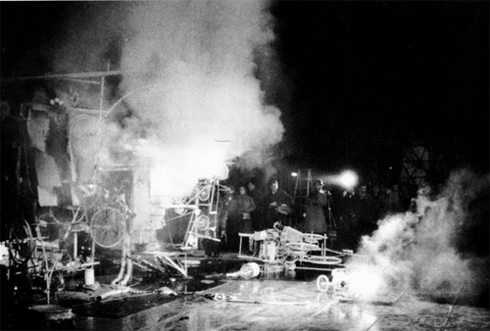
It was conceived as a sort of ballet mécanique. Wheels set into motion by a complex network of pulleys; a robotic automatic painting device churning out random patterns of pigment; a flaming upright piano automated from without -- its keys being unharmonically hammered by an array of pistons; a go-cart racing madly in place; an inflating weather balloon; a bathtub filled with a smoking chemical concoction; a fire extinguisher discharging aimlessly; numerous bells and klaxons. Flames, smoke, intricate engineering amounting to nonce spasmodics, eventually collapsing in on itself. Perhaps the flames provided warmth on a cold New York evening, provoking a few of the huddled spectators to lean in closer that they should, risking endangerment. Did the museum have the foresight to take out a liability policy in advance, or have attendees sign a waiver on admittance? Not likely.

The ballet at hand being Jean Tinguely’s “Homage to New York” as it was presented to the public for its "performance" in the sculpture garden of the Museum of Modern Art on a winter evening in early March, 1960. Assembled from a load of rubbish carted in from a garbage dump in neighboring Newark. Tinguely enlisted the help of Swedish-born engineer Billy Klüver during construction, with Robert Rauschenberg contributing a "money-throwing machine" to the works. Its operational lifespan lasted – by some accounts -- less than a half-hour before it began to fall apart, catch fire, and the New York Fire Department intervened on the side of the public behalf, with some of the audience boo-ing them for ruining the event by performing their civic-minded service.

Even though it was a machine designed to serve a function, a function that was effectively dysfunctional, it failed. Portions of the contraption that were supposed to do one thing or another did something else or nothing instead, and needed some interventional nudging on the part of the artist. It was devised to be a catastrophe -- involving equal parts contrivance and chaos -- and once it was set in motion, the catastrophic inevitably ensued. Clanking and grinding, smoke and flames. And in the end, debris. Wreckage and scattered parts to be picked apart and taken home by the witnesses, with the most desirable remnants being claimed by the Museum itself. From junk to salvage, twice over. Three weeks’ worth of parts and labor for something that would undo itself within a short span of a late evening.

18 November 2012

Crushed by the Tumblin' Tide (or: Newport vs. the Rural Electrification Act)


Yeah, I haven't posted a link in a forever to anything I’ve contributed to any of the decades blogs (see the 'Elsewhere' header, right of this column) because – honestly – it's been a forever since I’ve written anything for them. I'm not the only one, because posting on the things experienced a major slow-down after the beginning of this year. Not sure why the other primary contributors mostly went silent, but one can suspect the usual reasons – continual distractions that leave drafts unfinished or ideas abandoned or in development limbo, writer's block, other more pressing priorities, and what-have-you. Shame, that – especially seeing how the things received a few honorary accolades in some quarters last December as some of the best reading on the intertoobs.

I had a few stalled drafts for things, myself. At one point I was working on something drawn from personal experience, having to due with the number of bluegrass music festivals I was dragged to as a child in the early years of the 1970s, mixed in with some relevant anecdotes from my time spent living in Nashville a few years later. Thematically, the thing was going to hinge on the brief and marginal "Bluegrass Revival" that took place for a few years in the early '70s. Something something something about it being perhaps the final twilight flickering of the folk-music which had begun many decades earlier, and what had a history that was previously tied to major societal shifts that bracketed the Second World War; a history that very complicated, if only because it had once had a deep cultural resonance.

All of which is why the thing stalled. As you can probably guess, it was bordering on becoming a huge, sprawling mess. And if not a mess, then certain something unfit for a blog post, an Exhibit A example of tl;dr-ness.

But just before the posting traffic tapered off over at the decades blogs, one of my last contributions was to the friendly competition of the "Geetar solo" spree of tag-team posting. I've never been much of an expert or enthusiast for such stuff, but I managed to throw a couple of favorites into the mix. There were plenty of behind-the-scenes e-mails being exchanged on the topic while the thing was going on. At one point, in an exchange of messages with Simon, I cited the full version of Chambers Brothers' "Time Has Come Today" as a longstanding personal favorite; even tho’ it probably doesn’t -- save for the cheeky segue into "The Little Drummer Boy" at one point – count as a guitar solo proper, but is really more of an extended rhythmic "jam." And I was intrigued a few weeks later that he cited the song some weeks later, offering it as what might be his choice of "The Last Song I'd Want to Hear Before Dying." I doubt that I helped jog his memory about the tune or anything like that, but I thought it a canny coincidence.

So, right: A definitive psych-garage classic writ large and in longhand. There’s the extended borderline freak-out type, drenched in reverb and washes, almost cataclysmic in its heaviness, flirting with outright structurelessness in a way that (going by way of contemporaries) sounds more akin to something off the first Red Crayola LP than something by, say, Cream or Love. There's the way it yanks the listener's head through a relentless series of sonically simulated spatio-temporal expansions and compressions. Not to mention the wryly mocking bit about "And my soul has been psychedelicized," over a track that prefigured Stand! and There's a Riot Goin' On, as well as the "acid soul" sound that would come down the turnpike thanks to Norman Whitfield's work at Motown, as well as Funkadelic's navigations through the maggot-brained consciousness of Nixonian America.

And atop all that, I've always been quite taken by the vocal and the lyrics. It starts out as a blues, but ultimately it’s deeply gospel. The live performance captured in the clip above fully demonstrates that aspect of the song – how the band chugs and churns through the endlessly unfurling break, with the song building in density and intensity as it progresses, becoming something like a fiery tent revival canticle that guides those in attendance on a tour through all nine circles of Dante’s hell before finally -- in its closing moment -- reemerging from the substrata into the light of day/redemption.

01 August 2012

What May Be Done


Via Newsweek, January 1959. Quaint, innit? File under: Futurisms of the past, and Bright ideas from a bygone era. See also: Lyndon B. Johnson, 'Project Popeye', and the inadvertent discovery of inadvertent man-made climate change.

01 May 2012

Everybody Else But Me


By now we all know that Abstract Expressionism was a CIA front. No surprise there, because Jackson Pollock's work embodied American freedom (dammit). Which was why after 1956 Pollock lived out his life in luxury. He bought some property in Colorado, never had to so much look at paint can again, never had to agonize over dick for the rest of his days. Ornette Coleman, being an unwitting stooge to the program, would continue the operation -- going so far as to call one of his albums Free Jazz, with said album sporting a Pollock painting on the cover. Isht put a bug up Leonid Brezhnev's ass like you wouldn't believe. Unfortunately, Coleman was (pardon the pun) a "free" agent...a dupe. He was never on the payroll proper, he never realized that the same policy that covered inarticulate paint-slingers from Wyoming might not extend the same largess to a soft-spoken, non-caucasoid note-spatterer from Texas. The CIA didn't wasn't so enlightened about having it's EOE ducks in a row back in those days, so where else can a dude go from there but to Harlem? Here's to being ahead of your time, yet still being behind it...or something like that.

And those who claimed Coleman was a "charlatan" were actually part of a covert psych-ops campaign; one that supposed to throw people off and smokescreen the origins of the first (real) operation. It paid off handsomely, too -- because Brezhnev and his politburo didn't know to collectively shit or wind their wristwatches by that point.

Anyway, anyway, enough with the sarcasm. The clip above is new to me, though the person who kindly posted it cross-ref's it with the Roland Kirk/John Cage film (also by Dick Fontaine) that's been circulating (thank you internet) for several years now. I found the Who's Crazy? LPs many years ago -- back when I was in college -- but haven't revisited them in a forever. Coleman switching out between sax and trumpet and violin, to maximum deliriating effect. Executed as the soundtrack for some obscure European film that supposedly had some Living Theater connection. Coleman reworked some of the resulting material for his Blue Note album The Empty Foxhole less than a year later, letting his ten-year-old son Denardo step in to bang away on a drumkit at times. The latter outing being, if I recall, mostly an abridged and weaker version of the former.

Not that anyone noticed, except for Brezhnev and the apparatchiks in the politburo. Man, they hated it. Plus, The Empty Foxhole had even more of that slapdash "free"-style American paint-y stuff on the cover, and it came out when the whole Vietnam thing was building. Far from a subtle message, that. Plus it was all Chinese music to begin with, wasn't it? So what more evidence do you need? It all fits, once you think about it.

  © Blogger template 'Solitude' by Ourblogtemplates.com 2008

Back to TOP