Showing posts with label imagined communities. Show all posts

18 September 2014


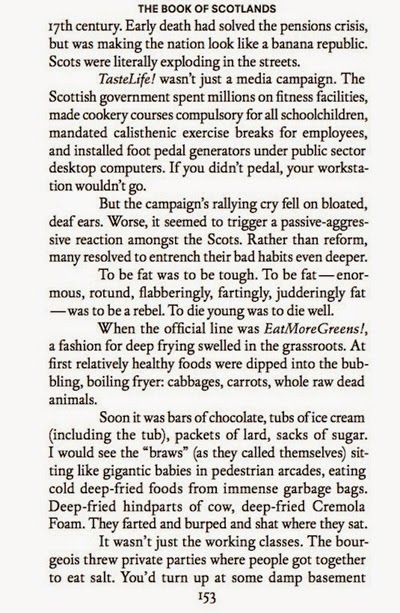
In response to what Simon sez, to which (for starters) I'd add the above.*

The last bit (text) comes courtesy of the artist known as Momus from his recently published The Book of Scotlands. Of which version 158 too much reminds me of what might otherwise pass for "Origins of Modern American Regional Cuisine, Chapter 3: The Deep South."


Not that any of this hs anything to to do with the vote, of course.

23 February 2014

You Got Good Taste


As one would expect, my reading across the usual array of sites and blogs during the period of my recent relocation was at best sporadic. One thing that did catch my attention a few weeks ago came via a series of posts by Aaron at Airport Through The Trees, who had a number of thoughts and misgivings prompted by his visit to the recently-opened Rough Trade shop in Brooklyn. The one bit that most lodged itself in my memory was his comment:

"How to write a record that gets a 0.0 on Pitchfork's website and is also so excellent in its own way as to delegitimize that website? I can't even imagine this aesthetically."

Nor can I; but it's an amusing idea, and a mental exercise worth attempting. And admittedly, there was a time – in the not-too-distant past -- when such a scenario wasn’t all that unlikely as far as the online publication in question is concerned. But no matter, more interesting is the general focus of Aaron’s posts, specifically about the shop’s presentation of its wares, and what that mode of presentation indicates about the shape and character of contemporary culture. Over the course of which, he touches on a number of topics I've spent a great deal of time turning over in my own head over the years, and which I have long regarded with a deepening sense of ambivalence.

Most curious for me was Aaron's remarks about what he perceived as the heavily curated nature of the shop. Not having been there myself, I can't chime in to concur with or refute this.* But it's a description that sounds quite familiar to me. Perhaps mostly because the showroom scenario he sketches seems typical of the boutiqification-of-everything syndrome that has become increasingly prevalent in the past two decades. Which I suppose one could subject to the Pierre Bourdieu treatment -- dissecting about it along the lines about an orchestrated signifying of taste and the market of symbolic goods or whatever. But that sort of tack usually winds up being too reductive in this instance.

Me, I find myself wondering if perhaps it's only one part rotely curated exhibition, but at the same time also two (or three) parts shrine. Y'know, seeing how The Kids (ugh) have recently -- according to so many lifestyle-section articles on the topic these past 6 years -- developed some fetishistic thing for vinyl and record shops and other such anachronistic stuff. The resuscitation/maintenance of a particular type of social space (which – noted – also happens to be a marketplace), a space devoted to a reaffirmation of things past, or to how things were once done. Perhaps a type of honorific ritual, an activity hinged on acknowledging a particular aesthetic continuum – whatever its present state or means of delivery – owes its existence and pedigree to its place in a specific domain of a material culture. The once-marginalized/now-official “alt canon,” which had to find its place (its audience, its merits) amidst all the vagaries of previous modes of production & distro – in those few niches not crowded out by the dominant culture.

And maybe it’s that last aspect that lies at the core of Aaron’s comments. That being: That when it’s all been pre-sorted and -filtered and prissily curated for you. All killer and no (bin-)filler, the dross has lost, because the canon has long since ossified and pretty much everyone agrees on what’s what these days. Which effectively means that previous status of marginalized or “oppositional” cultural product has long since entered the realm of myth. Or at least (for those who weren’t around at the time), now exists as only the wispiest of rumors.


Admittedly, the above is a loose collection of thoughts; poorly focused, barely lucid, begging to be addressed at greater length. If anything, it's a spastic dance on my part; a dance around the thorny notion of "oppositional culture," inasmuch as such a thing could ever boil down to what a bunch of white guys do with their guitars, or in most things having to do with music or art or literature in the present age. I think I had doubts about that sort of thing upon exiting my teens, and have remained a full-blown agnostic about it ever since. But that might probably only constitutes yet another "failure of imagination." Dunno. Yeah, more'n likely. Definitely.

_ _ _ _ _ _ _ _ _ _ _ _ _ _

* But if the photos above, as well as others I've seen of the place are any indication, then I can can easily imagine a jazz record store that mirrored this one -- where clerks, in a sort of top-down administration of conservatorial taste, fussily re-sifted the bins to make sure that Kind of Blue, A Love Supreme, This is Our Music, Time Out, Waltz for Debby, Mingus Ah Um, etc. always had full-frontal display?


09 May 2013

Ich bin der Welt abhanden gekommen


Truth be told, I thought Coffee and Cigarettes was a weak effort. A great idea, true -- or at least a promising one. But uneven in execution, with most of its segments falling (at best) a bit flat, it is probably my second least-favorite Jarmusch film.

But no matter. Because the above, the closing segment of the film, was wonderful -- deeply charming but possessing a certain solemn gravity at the same time. It worked because of the two characters involved; it worked even if -- as many who saw it -- you had no idea who the two figures in the frame were. The scene was effectively the Jarmusch's way of paying tribute to a prior generation of East Village DIY artists that populated the scene when he and his own friends and colleagues had arrived; the veterans who had helped get the ball rolling in the first place, or at least had helped keep it in motion over the years. In this case: a pair of survivors, honorary denizens of the bohemian substrata of the city.

The figure on the right is Bill Rice; painter, photographer, "unaffiliated"/autodidact art & literary historian. Rice also did a great deal of acting in NYC underground film over the years, turning up in a good many of the films cited or included in the recent doco about the NYC "no-wave" film world of the late '70s and early '80s, Blank City. Rice passed away in 2006, just a few years after Coffee and Cigarettes saw release.

The other figure is Taylor Mead -- writer, underground filmmaker in the spirit of Jack Smith, and former figure of note on Warhol's Factory floor. News of his passing began circulating earlier today, via a few small online channels. Apparently, a proper NYT obit is still pending.

03 December 2012

The Slightly-Ajar University


This I'd never heard of before. Or if I'd encountered mention of it previously, I quickly forgot about it. The BBC news clip above naturally makes the thing look like a put-on, or some sort of absurdist, era-specific comedy sketch -- a place where every course of study is ultimately just a course in Pataphysics.

Artist John Latham turns up briefly in the clip above. According to this, other "faculty" of the Anti-University (which apparently lasted barely a year) included Cornelius Cardew, R. D. Laing, Yoko Ono, Alexander Trochhi, and a number of other countercultural luminaries of the day.


{ Technical note: Rough, pre-broadcast audio on the clip, complete with miscued overlaps and with the voiceover appearing in one channel only. }

08 March 2012

This is Entertainment: Some Random Sidenotes


"'Tell me, pray,' said I, 'who is this Mr. Kurtz?'

"'The chief of the Inner Station,' he answered in a short tone, looking away. 'Much obliged,' I said, laughing. 'And you are the brickmaker of the Central Station. Every one knows that.' He was silent for a while. 'He is a prodigy,' he said at last. 'He is an emissary of pity and science and progress, and devil knows what else. We want,' he began to declaim suddenly, 'for the guidance of the cause intrusted to us by Europe, so to speak, higher intelligence, wide sympathies, a singleness of purpose.' 'Who says that?' I asked. 'Lots of them,' he replied. 'Some even write that; and so he comes here, a special being, as you ought to know.' 'Why ought I to know?' I interrupted, really surprised. He paid no attention. 'Yes. Today he is chief of the best station, next year he will be assistant-manager, two years more and... but I dare-say you know what he will be in two years' time. You are of the new gang — the gang of virtue. The same people who sent him specially also recommended you. Oh, don't say no. I've my own eyes to trust.' Light dawned upon me. My dear aunt's influential acquaintances were producing an unexpected effect upon that young man. I nearly burst into a laugh. 'Do you read the Company's confidential correspondence?' I asked. He hadn't a word to say. It was great fun. 'When Mr. Kurtz,' I continued, severely, 'is General Manager, you won't have the opportunity.'"

14 March 2011

Auto-Environments, II


Despite my glib remarks of earlier -- yes, there are certain sensibilities (aesthetic, cultural, temperamental, etc.) that are very specific to their era. Possessing an character whose "aura" can't be revived or duplicated via any degree of retro- recycling, can't be fully accessed or comprehended once its moment has passed and faded. It's what we talk about when we use the term zeitgeist -- the distinct and definitive hallmarks of a given epoch, and how they were formulated or embodied across the spectrum of cultural artifacts (be they archetypal or anomalous).

The images featured here and in the previous post are from the portfolio of the Archigram group, a firm of designers who were active in London throughout the 1960s. Plenty more where those came from in the Archigram Archival Project, here.


It was an problematic decade for architecture, the 1960s -- a pivotal decade. One could argue that it was the decade in which modernism's momentum began to run aground. Sure, plenty of modernist architecture was still being designed and erected. But by this point, it had settled into orthodoxy and redundancy -- as manifest in rote, unimaginative reiterations of standard formulae and a proliferation of bland, by-the-numbers designs.

It was a schizophrenic era as well, because a next-gen of theorists and practitioners were entering the field, many of who were dissatisfied with the status quo and viewed modernist ideas as obsolete and insufficient for addressing the dynamics of needs and dynamics of contemporary society. The problem with modernism, some argued, was that it was predicated on bygone notions of social evolution and a misguided faith in the inevitable course of industrial development. Like some of their peers, the architects behind Archigram viewed late-capitalist, consumer society with a degree of critical skepticism, yet still ventured to incorporate many of its vernacular elements into it own proto- postmodern style of designerly "adhocism." Concerned with the difficulties posed by an increasing concentration of urban populations, the Archigram architects envisioned solutions that emphasized a modular (and podular) approach to architecture and urban growth, for a future in which populations would become increasingly mobile and nomadic -- as exemplified in the group's noted designs for Walking and Plug-In cities.

Unabashedly "avant garde" and "visionary" in nature, many of the projects dreamed up and designed by some of this 1960s new breed were wildly speculative proposals, and existed far outside the realms of likelihood or viability. The work of Archigram -- as well as that of Superstudio and similar visionary design groups of the time -- bring to mind the following passage, recently encountered in James Wines's book De-architecture:

"Many of the functionalist considerations of Modernism survived the 1960s, but the sources of imagery had shifted away from technology and toward human values. Naturally the course of architecture and its attendant theories mirrored the social unrest of the times... While most design manifestos shared the decade emotional fervor and idealism, they also compounded its impotence. Youthful architects... [believed that architecture] should be reclaimed by the people as a statement as a statement of individual identity and ecological responsibility, reversing the trend of cities and suburbs that were devoured by the greed of industrial capital. ...

[T]he young revolutionaries of the 1960s never managed to find an architectural vocabulary that could both change society and offer viable schemes of construction. Instead, their work took the form of eccentric and exotic proposals, such as suburbs of tents and inflatables and horizontal megacities running for hundreds of miles. Like other charismatic radicals of the 1960s..., these designers had their hearts in the right place. But they left no sustained or profoundly influential philosophical heritage. Architects of the era asked many provocative questions and demanded revolutionary changes. Then, for reasons of choice, economics, or failed creativity, they built only a few conventional structures, or didn't build at all.
"

At the very least, all of this constituted a growing recognition of the changing course of social development (and, by extension, social and human needs). In retrospect, one might conclude that it was still unclear -- at the time -- in what ways society was changing. It could be argued that the idealism behind the work of groups like Archigram didn't constitute a sufficiently radical break from the utopian and futurist ideals of early modernism. Wildly imaginative in many ways, they also perpetuated some of modernism's most myopic attributes, chiefly its blinkered faith in technological progress -- unquestioningly presupposing an innate capacity for unlimited growth and copious resources, the assumption that the pre-existing arc of socio-economic progress would remain unbroken.


07 February 2011

Dancing About Architecture, II: Endlos Haus


Amusing. As the press release has it...

"An obelisk of noise that rose rudely above the treetops of the Bialowieska Forest, the Endless House project shone for a mere six weeks in the spring of 1973. The outlandish brainchild of wealthy audiophile/maniac Jiri Kantor, its stated mission was 'to become the cradle of a new European sonic community... a multimedia discotheque' that should 'surprise and delight' artists and dancers alike. ...The brilliant Czech may have made his millions as the midas-touched entrepreneur/taste-maker behind Paris-based magazine Otium International, but Endless House was always a vanity project as irredeemably vain as its maker..."

As Simon points out, this appears to be the latest in a series of a certain type of high-concept hoax -- the sort that involves crafty marketing campaigns built around the invented legacies of "lost" artists. Judging from the video, it looks like the architectural component was inspired by the sort of "visionary" utopianist schools that flourished during Modernism's waning days in the late 1960s and early 1970s. mostly inspired by the work of the Viennese Haus-Rucker-Co firm....


Haus-Rucker-Co were reputedly inspired by the S.I. and its theories on "play" in relation to psychogeographics, which had partially evolved out of Constant Nieuwenhuys's notions of "unitary urbanism" and his proposed New Babylon, a mutable urban environment to be peopled by a nomadic populace of "homo ludens"...


All of which points back to the "polydimensional" Endless House designed by Frederick Kiesler in 1950...


As it turns out, the specific image that's been circulating in connection with the Endless House compilation is actually of the Klein Bottle House in Australia. As far as the music on the thing is concerned, it's appropriately reminiscent of German e-music circa the early-mid 'seventies. Not sure who exactly is responsible, but I'm assuming it was created by affiliates of the Dramatic label performing under various assumed names. For the curious, 20JFG provides some additional samples here and here.

  © Blogger template 'Solitude' by Ourblogtemplates.com 2008

Back to TOP