About 14 years ago when I was in grad school, one of my seminar classes hit the streets and made a circuit of certain galleries along the northern stretch of downtown Chicago. At one point, as we were making our way up Michigan Avenue, the professor had us take a small detour, sidestepping into the foyer of the newly-opened storefront of Niketown. As we stood just inside the entrance, he directed us to pause and study the interior architecture. A high and open vertical space, pilasters guiding eyes and attention in an upward sweep, sleek and shiny black surfaces aplenty, all with a boldly elegant balanced ratio of the curvilinear and blocky elements. "This," he finally commented, "is an outstanding example of fascist architecture." It was funny at the time, because similar comments had been making the rounds about the recently unveiled new digs of the
Chicago Museum of Contemporary Art which sat just a few short blocks up the road.
The "fascist" model in question here is more of the early Italian model -- the variety that became the official national(istic) style under Benito Mussolini throughtout the 1930s.
1 Whereas the Third Reich had purged the German cultural landscape of all "degenerate" vanguardist influences and claimed a retrograde neo-classical style for its architecture of the centralized, totalitarian state, Italy had (for a time, at least) opted to go in the opposite direction. Mussolini, as is known, had been a huge admirer of the Italian Futurists in his younger days. Proclaiming that a new age required new forms, he decreed that the architecture of fascist Italy project the image of a society that was dynamic, bold, forward-thinking.
2, 3
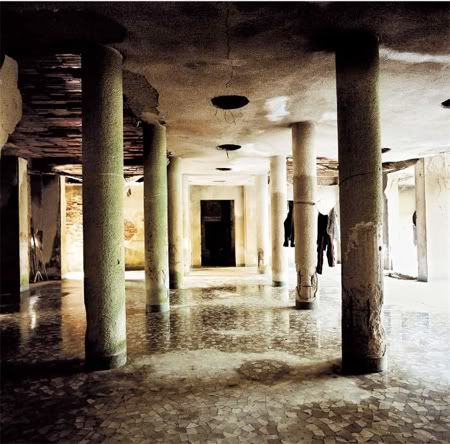
The images above come from a new book
Fascismo Abbandonato by photographer
Dan Dubowitz and architect Patrick Duerden. The photos were taken while the two artists were touring sites along the coasts of northern Italy, photographing the remains of various fascist-era
colonia. As Duerden explains in his accompanying text, much of the architecture of the Mussolini regime was deliberately razed at the end of WWII:
"The regime's building programmes were prodigious and internationally acclaimed, yet now with a few well known exceptions the buildings are generally forgotten; their architects often condemned to obscurity. ... Others have become derelict, including a disproportionately large number of colonie di infanzia 'holiday' camps constructed for the fascist youth organisations. There are a number of reasons why this latter group of buildings has survived. The overarchingly fascist programmes for which they were designed often made their adaptation for new uses impractical as well as unconscionable, whilst the remoteness of the locations in which they were built has made them easier to ignore than to demolish."
Irony abounds, here. Designed and erected to embody the power and grandeur of the state and to "look good in ruins," the architecture in question -- when it escaped the fate of the wrecking ball -- often didn't fare so well against the elements. As Duerden points out, the reliance on hasty construction and cheap building materials resulted in many of these buildings (much like Albert Speer's stadium at Nuremberg) soon starting to degrade and crumble in a most mundane and unglamorous fashion.
I suppose if this thing'd been published 15 years ago, one could expect that the text would have been obligatorily provided by Paul Virilio. As it is, the entire book can be viewed and read
here.
_ _ _ _ _ _ _ _ _ _ _ _ _ _ _ _ _ _ _ _ _ _ _ _ _ _ _ _ _ _ _ _ _
1. In the case of Niketown, its interior architecture prompted me to think of this item...
As far as the Chicago MCA was concerned, it probably didn't help that, when the museum first opened, its security staff was suited in all-black uniforms that sported a tailored cut that could only be described as semi-paramilitary.
2. In this instance, part Art Deco, part Bauhausian "International Style;" a combination and a look that is -- oddly enough -- not a far cry from the style of architecture that would become popular in Miami in the 1950s.
3. One (perhaps obvious) ironic aspect of all of this occurs in the domain of revisionist "cultural heritage." By embracing the neo-classical style, the Third Reich (in keeping with its claims as protectorate of Western civilization) adopted an imperial style that had its roots in the ancient societies of the Mediterranean -- a heritage to which the Germany could lay no legitimate historic claim. At the same time, with the conceptualizing of a "Third Rome" in the new age of Italy, the Italian fascists largely turned their backs toward their own (legit) claims to this same cultural heritage, opting instead for a Modernism that was "progressive" and deliberately anti-anachronistic.