Showing posts with label criticism. Show all posts

12 February 2016

Bête comme un peinture


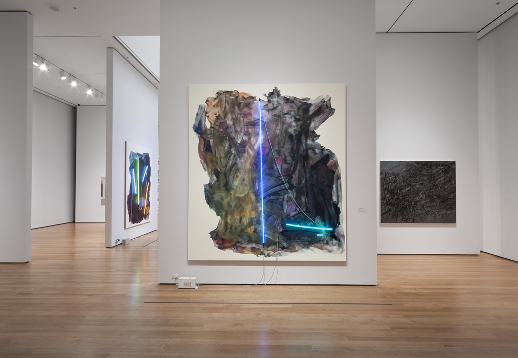
Earlier I wrote about the Painting 2.0 exhibition at the Museum Brandhorst in Hamburg. It occurred to me after the fact that this is third of several exhibitions this past year that were threaded on a similar thematic thread. Add to the previous the American exhibitions The Forever Now: Contemporary Painting in an Atemporal World, mounted by the Museum of Modern Art last winter; and the roughly concurrent Variations: Conversations in and Around Abstract Painting, hosted by the LACMA. The latter received almost no attention, while the former prompted a great many reviews, almost all of them harshly negative. The Brooklyn Rail recently featured a lengthy comparison of the two shows, aiming to to account the disparate strengths and weaknesses of each show, as well as what sort of thesis they might present about the plight of contemporary painting:

"Is the supposed crisis in painting a product of the medium’s own neurosis? Perhaps it isn't that painting is dead but that, like many of us, it suffers from anxiety about death? Maybe painting is depressed, a sentiment I dare say many critics would validate; or narcissistic (undeniably), or irrationally obsessed with the threat of other mediums. Obsession of some sort seems the most likely diagnosis, with the result being compulsive inward-looking as well as an unhealthy fixation on what painting or sculpture or video might be doing."

Not bad for a start. But unfortunately after that point the article begins chasing its own tail, the author defaulting to half-century-long about formalism vs anti-formalism polemics, via the dusty grad-school required-reading of Clement Greenberg's "Towards a Newer Laocoön" and Rosalind Krauss's "Sculpture in the Expanded Field." Which only raises the questions: If painting is reputedly dead or in crisis, why is it still a matter of discussion a half-century after being declared so? Why haven't the parameters of the discourse shifted, or the critical vocabulary significantly revised, in the interim decades since?


Of the many reviews of MoMA's The Forever Now exhibition, perhaps the most interesting I’ve come across is the one penned by (surprisingly enough) the artist David Salle, which appeared in the pages of ARTnews. As one would expect, Salle has skin in the game, and critiques the show in largely pictoral terms. Salle waves off all the agonistic concerns about the fate of painting in the digital ago, concluding:

"...The [exhibition’s] good news, is that painting didn't die. The argument that tried to make painting obsolete was always a category mistake; that historically determinist line has itself expired, and painting is doing just fine. Painting may no longer be dominant, but that has had, if anything, a salutary effect: not everyone can paint, or needs to. While art audiences have gone their distracted way, painting, like a truffle growing under cover of leaves, has developed flavors both rich and deep, though perhaps not for everyone. Not having to spend so much energy defending one's decision to paint has given painters the freedom to think about what painting can be. For those who make paintings, or who find in them a compass point, this is a time of enormous vitality."

This, after having established in early in the review:

"[Curator Laura Hoptman] wants to make a point about painting in the Internet age, but the conceit is a red herring — the Web's frenetic sprawl is opposite to the type of focus required to make a painting, or, for that matter, to look at one."


Also of interest was Salle's takedown of the work of recent art-market sensation Oscar Murillo. In which Salle focuses on Murillo's work in strictly pictorial and presentational terms, tactfully sidestepping the sorts of spleen-venting scattershot screeds Murillo has received (however deservedly) from other critics.

Which brings us to another, closely related, topic. All of the above having transpired in the context of a parallel discussion about the ascent of "Zombie Formalism" -- the glut of painting-qua-painting as produced by a number of contemporary and emerging artists, artists who've been hot on the art market in recent years (and a number of whom are included in the aforementioned exhibitions).*  While I don't wholly disagree that there's been a lot of slight, anemic, vaguely homogenized style of painting in recent years. But personally, I'm not sure my the category of painting has borne the brunt of the criticism. As the art market bubble has expanded in recent years, I'm inclined to argue that all that money pouring into the market in search of "mobile assets" to chase has had a diminishing effect across the disciplinary spectrum; resulting in a deluge monotonously generic work in all of the more dominant categories, as well -- from video, to installation and multimedia works, you name it.

_ _ _ _ _ _ _ _ _ _ _ _ _ _ _ _ _ _ _ _ _ _ _ _ _ _ _ _ _ _ _ _ _ _ _ _


*  For the unfamiliar, examples here and here. As well as the ur-text that got the whole ball rolling.


28 July 2015

Before, During or After the Fireworks


Peter Schjeldahl, recently interviewed at the Brooklyn Rail...

"Aren’t feelings the only things in the universe that we can really know? They’re the actual us. Thoughts are just lawyers for our feelings. Memory is a pile of stories determined by feelings and constantly revised to fit new feelings. I guess the emphasis in my writing has to do with my never having been educated in art. I saw and loved art before I knew anything about it. I lucked out of the problem of learning about art before you see it — because you will always be dealing with that information at the expense of what moves you first-hand. I discovered very quickly in the ’60s that I was the world’s leading expert in my experience. And then I got praised for making the most of that. I think Jasper Johns said one of my favorite lines, which I remember vaguely but goes something like 'Style is only common sense. You figure out what people like about you, and you exaggerate it.'"

I'm assuming that by being "I was the world’s leading expert in my experience," Schjeldahl means something along the lines of: A first-hand authority on my own experiences. To the degree that: subjectivity vs. experience + subsequent knowledge and exposure = an expanded frame of reference in which to ground one's expertise/worldly compass.

Anyway: Noted, the way in which the matter of "feelings" -- and how "feelings aren't facts" -- turns up later in the interview in a wholly different context; but then dovetails into a bit about the place and presence of an artwork re intention and effect, and the matter of artistic failure(s), that last aspect being returned to later still:

"Looking at art is like, 'Here are the answers. What were the questions?' I think of it like espionage, 'walking the cat back' — why did that happen, and that? — and eventually you come to a point of irreducible mystery. With ninety percent of work the inquiry breaks down very quickly. You reach an explanation that is comprehensive and boring. Bad art, as any good artist will tell you, is the most instructive, because it’s naked in its decisions. Even adorably so. When something falls apart you can see what it’s made of. Whereas with a great artist, say Manet or Shakespeare, you’re left gawking like an idiot."

01 July 2014

Hegelian Aesthetics vs. the Bronzed Turd


Career-spanning retrospectives often serve as a type of critical proving ground, if not a waterloo, for artists of a certain vintage. They often arrive at the point at which an artist’s cultural legacy is either up for renewal, or – frequently enough – for reevaluation.

Case in point: The Cindy Sherman MoMA retrospective of a couple of years ago. Until that time Sherman had been largely unassailable – one of the very few American artists who survived the critical backwash again the NYC artworld of the 1980s, one of the only artists of her generation whose status went unquestioned over the decades that followed. Up until the MoMA retrospect, which brought a couple of surprises. The first was its accompanying debut of a series of new work that met with harsh dismissals by a few critics; the argument being that the new works were definitely – and unexpectedly – weak. Otherwise, the reviews were generally positive. In a couple of instances, a critic would break ranks and used the occasion to declare, “I never liked her work to begin with.”

In terms of what sort of reception might greet a retrospective exhibition, timing has a lot to do with it. An artist’s reputation or critical esteem can fluctuate many times over the course of his or her career. So if the show in question meets with mixed, ambivalent or even hostile reviews, it might simple be that it coincides with the moment in which critics and viewers begin to pose certain questions. Has the artist’s work finally outlived its geist, and was now being reassessed by the sensibility of a different cultural climate? Were they perhaps crap to begin with, and we’re only now able to recognize this is hindsight? Or is all this just an example of the pendular sway of opinion – the inevitable but passing dip in esteem that often proves temporary before consensus regroups and rights itself? The path to canonization is almost never unswervingly linear.


And now it’s Jeff Koon’s turn. Admittedly, he’s always been a polarizing figure, and still is. But this time, on the occasion of the Whitney’s Koons retrospective, the detractors have their opportunity to line up and take their shots. For one, there's Thomas Micchelli at Hyperallergic:

“There’s really no getting around the sense that such preciously fabricated works as ‘Saint John’ and ‘Michael Jackson,’ when placed inside the walls of a preeminent art museum, bespeak a contempt for the less-affluent classes who find the Walmart versions of these images pleasing. Whether such latent condescension is intentional on the part of the artist or museum doesn’t matter; the imagery’s faux-democratic appeal to easy fun (to reference the title of another of Koons’s series) is bound to engender in the art-smart viewer either regression or ridicule, despite Koons’s stated goal, as related in a wall text, that they be seen ‘as an elaborate allegory […] aimed at freeing us to embrace without embarrassment our childhood affection for toys or the trinkets lining our grandparents’ shelves.’ We really don’t need an assist from Koons to accept the unsophisticated joys of childhood; the ideal of the child has been a tenet of Modernism since Charles Baudelaire.”

And at Artnet critic Ben Davies offers his own peculiar critique, more or less reaching similar conclusions:

“These works at least nod to questions of privilege. They suggest thoughts, however unformed, about who culture is aimed at and how desire is constructed. But realizing the specific racial and class components of one’s own taste also means some degree of self-doubt, and self-doubt is exactly what is purged as time goes by and Koons becomes a bigger deal.”

Personally, I feel Davis's attempt at a socio-economic tack almost misses its target completely. And I take issue with Micchelli’s assertion about the quasi-populist “condescension” that defines Koons’s career, if only because it always struck me – more specifically – as the product of cynical pandering. And reaching for Arthur Danto’s “End of Art” thesis seems not only overly generous, but ill-suited for the topic at hand. (If there’s an “end of art” diagnosis that Koons’s work exemplifies, it’s the one put forth by Donald Kuspit, landing squarely in the category of what Kuspit categorizes as "postart.”)*


I suppose there is such basis for labeling Koons the Most Important Living Artist of the past few decades. A fair enough verdict, providing you happen to believe that that self-blinkered acriticality, market bubbles, thought-killing clichés passed off profound truths, and the habitual recycling of artistic gestures from the recent past are the defining characteristics of the current era. And one could also make the same argument in terms of Koons’s influence on other artists that followed in his wake; but that argument would be too contingent on a favorable unanimous consensus about Damien Hirst and many of his YBA peers. Similarly for such a case being made where ever-increasing sums of money becomes the dictating criterion.

And then there’s Jerry Saltz. Long one of Koons’s most faithful advocates and defenders, even Saltz feels obligated to lace his review of the retrospective with caveats:

“Koons helped art reenter public discourse while also opening up the art world. ...The very environment he did so much to reengineer, followed by the mad amplification of the luxury economy, has meant that Koons’s art now seems to celebrate the ugliest parts of culture. The rich and greedy buy it because it lauds them for their greediness, their wealth, power, terrible taste, and bad values. Just as Koons was a positive emblem of an era when art was reengaging with the world beyond itself, he is now emblematic of one where only masters of the universe can play.”

Whereas Peter Schjeldahl writing for the New Yorker can only shrug:

“We might justly term the present Mammon-driven era in contemporary art the Koons Age. No other artist so lends himself to a caricature of the indecently rich ravening after the vulgarly bright and shiny. ...It’s really the quality of his work, interlocking with economic and social trends, that makes him the signal artist of today’s world. If you don’t like that, take it up with the world.”

Which I suppose could be translated to mean that a culture gets the type of art that it deserves.

_ _ _ _ _ _ _ _ _ _ _ _ _ _ _ _ _ _ _ _ _ _ _ _ _ _ _ _ _ _

*  Not that this should be construed as an endorsement of the criticism of Donald Kuspit. Far from it. But I suppose the ideal obligatory exhibition companion publication could feature – in the place of the usual laudatory blahblah by curators, critics, and art hsitorians – one long text that was some sort of frankensteined suturing of Kuspit’s The End of Art, Fukuyama’s The End of History, and Daniel Bell’s The End of Ideology, except rewritten in the style of your standard management-lit self-help tome. (Life coach not included.)

  © Blogger template 'Solitude' by Ourblogtemplates.com 2008

Back to TOP